You’re standing in front of a full pantry. Nothing sounds good. Or more accurately, everything sounds like a decision you don’t want to make right now.
Your kids are doing the same thing from the living room floor, surrounded by more toys than they could possibly play with in a day — and they’re bored.
This is not a gratitude problem. It’s not a discipline problem. It’s a design problem.

We Were Sold a Lie About More
Somewhere along the way, abundance became the language of good parenting. More options meant more love. A full pantry meant you were prepared. A playroom stocked to the ceiling meant your kids had everything they needed to thrive.
It’s hard not to absorb that message when it’s woven into so much of modern family life.
And I understand why. Most of us are trying to love our families well. More food, more activities, more opportunities — it all feels like care.
But what gets lost in all the messaging around abundance is this: more choices don’t feel like freedom. They feel like friction.
What Too Many Options Actually Costs You
Every choice is a small withdrawal from a finite account. Researchers call it decision fatigue — the mental depletion that comes from making too many decisions, regardless of how small they are.
Now multiply that across a day in a family home.
What do you want for breakfast? What are you wearing today? Which water bottle are you taking? Which snack? Can I sign up for this thing? Which movie should we watch? What do you want for dinner?
That’s before noon. And half of those decisions are being made by someone who doesn’t actually want to choose — they want to be told, in the gentlest possible way, what comes next.

This isn’t a parenting failure. It’s an environment problem. The environment is generating more decisions than anyone in the house can sustainably process.
The result isn’t always obvious. Sometimes it looks like irritability. Sometimes it looks like procrastination. Sometimes it sounds like, “I don’t care,” when someone has simply run out of mental energy to choose.
And with kids, it can look confusing. A meltdown over something small is often not about the thing itself — it’s about a day full of small decisions that have quietly drained their capacity to handle one more.
How It Shows Up
- The fully stocked closet with nothing to wear
- The playroom no one wants to play in
- The pantry full of ingredients that somehow never become a meal — and the takeout order that follows
- The kid who falls apart over something small because their decision-making capacity is already gone
The overwhelm isn’t coming from the shortage. It’s coming from the excess.
Fewer Choices, More Peace
This is also where I think people misunderstand the conversation. The goal isn’t minimalism for the sake of minimalism. The goal isn’t owning the fewest toys, the smallest wardrobe, or the most stripped-down pantry. The goal is learning which decisions deserve your energy and which ones don’t.
Most of us only have so much attention to spend in a day. When it gets used up on snack choices, outfit debates, and constant re-deciding of things we’ve already solved, there is less left for the things that actually matter — relationships, creativity, problem-solving, and the unexpected needs of real life.
What if the goal isn’t owning less?
What if the goal is deciding less?
Predictability reduces cognitive load for everyone in the house. When your kids know what to expect, they stop scanning for options and start living inside their day. That’s not restriction. That’s relief.
Editing as Care
This is where I want to be honest, because this part gets missed.
Editing your home — limiting options, creating defaults, deciding things once instead of repeatedly — has an upfront cost. Time. Mental energy. Sometimes money. It requires making decisions intentionally so you don’t have to keep making them over and over again.
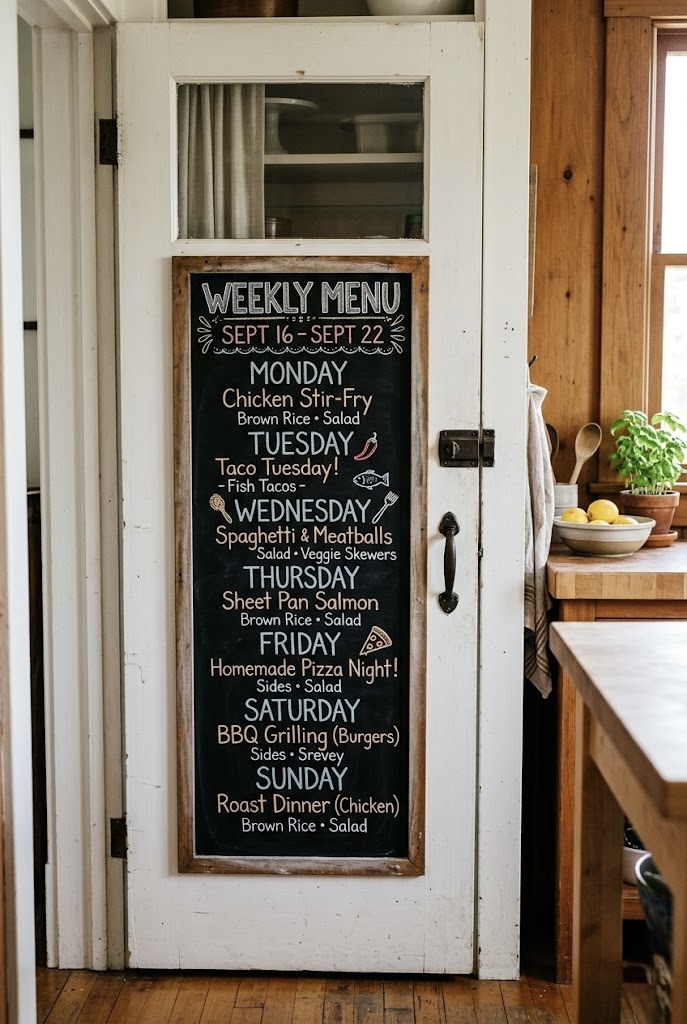
A few summers ago, I created a weekly food calendar — breakfast, lunch, dinner, snacks mapped out and visible to everyone.
The effect was immediate. “I’m hungry” stopped turning into a negotiation. My kids stopped circling the kitchen waiting for something to appear. Mealtimes got quieter.
But by week eight, reality crept back in. This was a system on my shoulders that I couldn’t sustain. Life happens. Systems loosen. You adjust.
What stayed wasn’t the perfect structure — it was the understanding underneath it: knowing what comes next is a gift you give your family. The work of deciding is yours, but you only have to do it once.
A simpler example is packing for vacation. When you reduce what you bring to what you actually need, everything gets easier. Less to track. Less to manage. More space for the trip itself.
Editing isn’t deprivation. It’s clarity. You’re not removing joy — you’re removing friction.
A Starter Kit: One Place to Begin
If you’re reading this and thinking, “That sounds nice, but where do I even start?” start small. You don’t need to overhaul your entire home. You don’t need a capsule lifestyle or a perfectly curated system.
You just need to remove one category of unnecessary decisions.
Start here:
This week, pick one area and simplify it.
- Maybe it’s after-school snacks — three options, rotated, done.
- Maybe it’s weeknight dinners — a short rotation of meals your family actually eats.
- Maybe it’s kids’ activities — one season, one commitment per child.
- Maybe it’s school mornings — laying out clothes or setting a default routine.
- Maybe it’s lunch packing — the same structure most days, instead of starting from scratch.
Don’t solve everything. Just solve one thing.
Then notice what changes.
You’re Not Restricting Your Family
You’re teaching your home how to function with less friction.
The goal was never perfection or minimalism. The goal is discernment — learning what deserves your energy and what doesn’t. Because not every decision is equally important. And not every moment needs to be optimized. Some things are worth thinking deeply about. And some things are just lunch.
If you’re noticing the same decisions, frustrations, and negotiations showing up again and again, it may not be a motivation problem. It may be a system that was never fully decided.
My Repetition Reset helps you identify those repeating decision points in your home and turn them into simple defaults that reduce daily stress.