There’s a specific kind of frustration that comes from asking your child, “Do you have homework tonight?” and hearing, “No”—when you know full well they have a spelling test on Friday.
They’re not necessarily lying to you. They may genuinely believe the answer is no.
Homework is the worksheet. The spelling test is the spelling test. One is something they’re supposed to do; the other is something that will simply happen on Friday. And if you’re the mom who has heard this conversation more than once, it can be maddening.
How many times do we have to talk about this?
For years, I found myself frustrated by moments like this. It felt like my kids should understand by now that a test on Friday means there are things to do before Friday. But eventually I started looking at the situation differently. Maybe the issue wasn’t that they didn’t care. Maybe they hadn’t yet learned how to recognize everything that a responsibility actually involves.
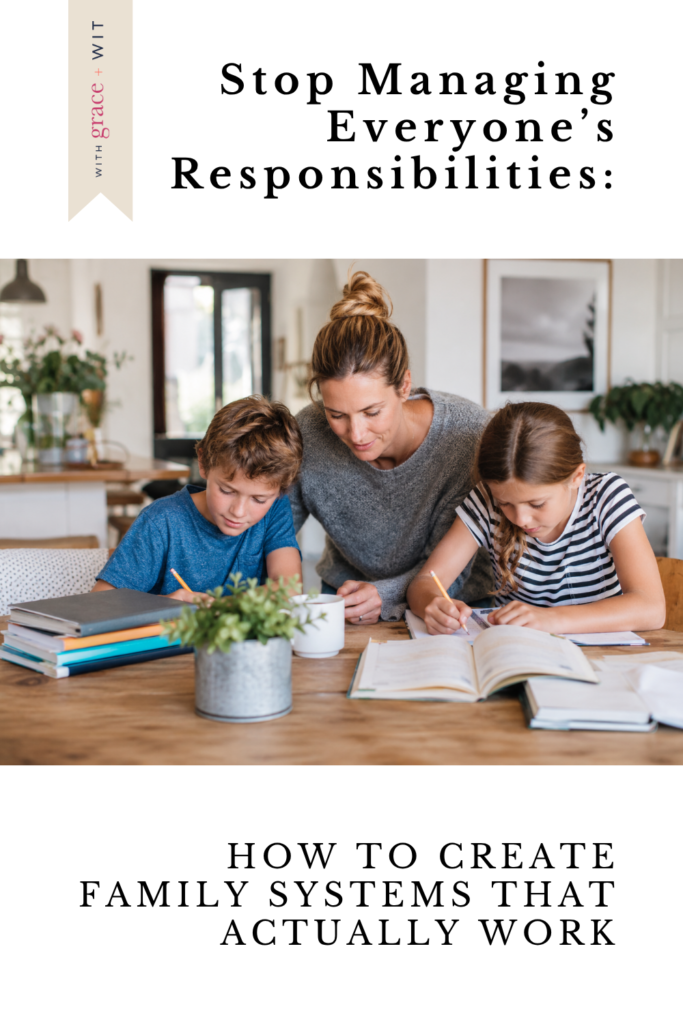
Because “study for your spelling test” sounds like a simple instruction to an adult. For a first grader, it can be a surprisingly complicated one.
What words are on the test? Which ones do I know? Which ones do I need to practice? When should I practice them? How many times? How do I know when I’m ready?
That is a lot of thinking for a child who is still learning how to think about tomorrow.
And it made me realize something:
The goal isn’t to get kids to do more. It’s to teach them how to recognize what needs to be done, understand what doing it requires, and gradually take responsibility for following through.
That’s what effective family systems for kids can actually do. They don’t just help a household run more smoothly. They can give children a structure for learning responsibility, independence, and how to manage their own lives.
We Already Know How to Teach “Done”
Parents are constantly being told to teach children chores by breaking them into steps.
Clean the bathroom.
Okay, but what does that mean?
- Empty the trash.
- Wipe the counter.
- Clean the sink.
- Clean the toilet.
- Sweep or mop the floor.
There are endless chore charts, printables, and Pinterest lists showing children exactly what “clean the bathroom” or “clean the basement” actually looks like.
And that’s good teaching.
“Clean the basement” is too vague for a child who is still learning how to organize a task. We break it down so they can see what the responsibility includes.
But we don’t always do the same thing with responsibilities that aren’t physical.
“Study for your test.”
“Get ready for school.”
“Take care of your sports stuff.”
“Prepare for your college interview.”
Those sound like instructions, but they’re actually bundles of smaller decisions and actions. And this is where family systems can do more than make a household run smoothly. They can help children learn how to think.
The question becomes less: “How do I get my child to do this?”
And more: “What does doing this actually involve, and which part are they ready to own?”
If you’re trying to build household systems that reduce the amount of responsibility that lives in your head, this connects to a bigger principle I’ve written about in why your home only works when you do: a system becomes much stronger when it doesn’t depend entirely on one person remembering, noticing, and managing everything.
The Goal Isn’t Better Reminders. It’s Kids Who Notice.
This is the shift I’ve been trying to make in our house: my job isn’t to become better at managing my kids’ responsibilities. It’s to gradually help them learn how to manage more of those responsibilities themselves. That doesn’t happen all at once.
A six-year-old needs more structure than a sixteen-year-old. A child learning to pack a backpack may need a checklist for years. A teenager who can manage a school schedule may still need help thinking through something completely new.

Independence isn’t a switch you turn on.
It’s something that develops as children learn to notice, understand, plan, act, and recover.
I’ve found it helpful to think about family responsibilities in three broad categories:
- Self-regulation — the routines and habits a child manages for themselves.
- Contribution — the work they do because they are part of a household.
- Advisory — the responsibilities older kids increasingly handle on their own, with a parent available as a resource rather than a manager.
The systems look different in each category, but the goal underneath them is the same: The goal is to move responsibility from parent to child as the child becomes ready to carry it.
That is what teaching children responsibility actually looks like in practice.
Self-Regulation: Learning What the Responsibility Actually Includes
This is the “brushing your teeth” category.
Does this sound familiar?
Your child disappears into the bathroom, comes back thirty seconds later, and announces, “I’m done.” Their breath smells minty. Technically, they brushed their teeth. But you know thirty seconds wasn’t enough to do the job well.
This is one of those everyday situations where children are learning that doing the motion isn’t always the same as completing the responsibility.
And the same thing happens with schoolwork. A child may check their assignment notebook and honestly report, “I don’t have homework.” They completed the step they thought they were supposed to complete: check for homework.
But they haven’t yet learned to ask the next question: What else do I need to know about tomorrow, this week, or Friday?
That is a more advanced skill.
It requires thinking beyond the immediate moment and understanding that something you do today can affect how something goes later. First graders are just beginning to develop that kind of thinking. And honestly, adults aren’t always great at it either. We procrastinate. We pull all-nighters. We forget to make appointments. We fail to save for things we know are coming.
So expecting a young child to automatically understand the long-term payoff of studying a little each night—or brushing carefully every night because of dental health years from now—is asking them to use a skill that is still developing.
The system, then, isn’t simply a reminder. It’s a way to make the invisible visible.
A first grader might need a checklist that says:
Spelling Test Friday
- Practice words
- Circle the tricky ones
- Practice those again
- Ask someone to quiz you
An older child may eventually need nothing more than a planner and a question: “What do you need to do before Friday?”
And eventually, you want the child asking themselves that question. That’s the progression. The checklist isn’t the goal.
This is also why routines work better when they are designed around the actual work involved rather than simply telling children to “remember.” A good family routine makes the next step easier to see.
Contribution: Chores Teach a Different Kind of Responsibility
Chores are often lumped together with personal routines, but they teach something different. Brushing your teeth is about taking care of yourself. Taking out the trash is about contributing to a household that belongs to more than you.
That distinction matters.
If nobody takes out the trash, everyone lives with the consequences. If nobody does the dishes, the whole household eventually runs out of clean ones. The work exists because a family is a shared system, and everyone who lives in that system has a part to play.
I often use a simple question when thinking about chores: Who does this affect?
That question helps sort out responsibilities that can otherwise become muddled.
Making your bed may be something you expect your child to do, but the consequences of skipping it are mostly contained to their own space. Taking out the overflowing kitchen trash affects everyone. Neither responsibility is necessarily more important. They’re simply different.
And this is another place where defining “done” helps.
“Clean the kitchen” might mean:
- Put away food
- Load the dishwasher
- Wash what can’t go in it
- Wipe the counters
- Sweep the floor
- Take out the trash
A child doesn’t have to guess what you mean.
If you need help building age-appropriate household responsibilities, my chore list guide is a practical place to start. But there’s another piece that becomes important as children get older: Eventually, you don’t want to be the person who has to define every job forever.
You want them to start seeing the overflowing trash and thinking, That needs to go out. You want them to notice that the dishwasher is full and know what happens next. You want them to walk into a messy shared space and understand that living in a family means contributing to it—not because Mom is standing there assigning tasks, but because they are part of the household.
That’s a much bigger lesson than learning how to scrub a toilet.
It’s learning to notice work that needs to be done and understand that some of it belongs to you.
Advisory: When Your Child Owns the Responsibility
This is where the shift becomes most obvious with older teens and young adults. At some point, your child needs to become the person who knows what is happening in their own life. They’re making appointments. They’re communicating with teachers or employers. They’re managing deadlines. They’re filling out forms. They’re figuring out transportation, money, schedules, work and school.

And sometimes they are going to call you.
“How do I find my routing number?”
“What am I supposed to put on this form?”
“I missed the deadline. What do I do now?”
“What should I say when I call them?”
Those calls don’t bother me. In fact, I like them. They mean the young adult is still willing to ask for help while also recognizing that they are the person responsible for solving the problem. That is very different from the parent who is still tracking the deadline, contacting the teacher, filling out the form, or calling on behalf of the child.
When I taught college students, I was surprised when a parent contacted me because their child had missed an exam. There is a difference between helping someone solve a problem and taking responsibility for the problem yourself.
That’s the advisory stage.
Your older child may still need you. They may need information, perspective, encouragement, or help figuring out what to do next. But you’re no longer the person keeping track of the entire project.
And sometimes the call really will be:
“I forgot.”
“Okay. What can you do about it?”
That’s not abandonment. It’s not refusing to help. It’s giving them the opportunity to practice recovering from their own mistakes.
And if you’re working on creating a household where responsibility doesn’t automatically flow back to Mom, this is closely connected to the idea of building home systems that work without you.
Your Child Will Still Forget
This is the part that can be difficult for parents.
You can have the checklist. You can explain what “done” looks like. You can create the routine. And your child will still forget.
They’ll procrastinate. They’ll decide studying can wait until tomorrow. They’ll leave the permission slip on the counter. They’ll forget their sports uniform. They’ll make a choice you know is going to end badly.
Sometimes the system will fail. Sometimes they will fail.
And sometimes you’ll need to step in because the consequences are too significant, the child isn’t ready, or the situation simply requires an adult.
That doesn’t mean the whole idea isn’t working.
The point of a family system isn’t to create children who never need reminders and never make mistakes. It’s to gradually move more of the thinking and responsibility onto them as they become capable of carrying it.
That may mean a checklist for one child and a calendar for another. It may mean reminding a younger child while an older child gets a chance to experience the consequence of forgetting. It may mean sitting beside a teenager while they make an uncomfortable phone call instead of making it for them. It may mean helping a college student figure out how to recover from a mistake without calling the professor yourself.
You don’t go from zero to one hundred.
You hand over pieces. You watch. You adjust.
You give more support when the demands increase or the child isn’t ready, and you step back when they’re capable of doing more themselves.
The system changes because the child changes. That flexibility matters. A family system that works for a six-year-old should not look exactly like one that works for a sixteen-year-old.
And the same principle applies to the adults in the household: the goal isn’t to stay “on top of everything,” but to build systems that reduce the amount of remembering and managing you have to do.
The Same Goal, Different at Every Stage
A spelling test in first grade, a messy kitchen in middle school, a forgotten deadline in high school, and a missed appointment in college don’t look like the same kind of problem.
But underneath them is a similar question: Can this person recognize what needs attention, understand what doing it requires, and take the next step?
That’s what we’re really teaching. Not just how to brush their teeth. Not just how to clean a bathroom. Not just how to remember their homework.
We’re teaching them how to look at their own life and say: “What needs to happen here?”
And that takes time. It also takes practice. Children learn responsibility by actually carrying responsibility—not by being given a lecture about it.
A Practical Place to Start
Pick one responsibility your child is struggling with—not because you want them to do more, but because you can see that they are not quite managing the responsibility yet.
Then break it down.
Ask: What does “done” actually look like?
What are the steps?
What needs to happen first?
What needs to happen later?
What part does my child understand?
What part are they missing?
And most importantly: What part can I help them learn to own next?
You may still need to remind them.
You may need to make the checklist.
You may need to sit beside them the first few times.
That’s not failure.That’s teaching.
And if you’re not sure where the friction is coming from in the first place, start by identifying the recurring frustration rather than trying to fix everything at once. That’s the thinking behind my Repetition Reset, which is designed to help you find the part of a household system that keeps creating the same problem.
The goal isn’t to build a perfect system that makes your children completely independent. The goal is to keep making yourself a little less necessary.
Because eventually, you don’t want to be the person asking: “Did you study for your spelling test?”
You want them to look at Friday on the calendar and think: “I have a test coming. What do I need to do?”
That’s the kind of independence worth building.