Last week, I asked you to notice what’s coming. This week, we’re doing something with it.
The holiday season has a way of filling up before you realize it has started. Halloween brings costumes and school parties. Thanksgiving adds travel, meals, and family gatherings. Then comes December, with Christmas programs, gift exchanges, parties, traditions, shopping, and people coming home. By New Year’s, you may be wondering how the calendar got so full.
You’re decorating the Christmas tree. A string of lights goes out. You go to the closet to grab a replacement, and there isn’t one — so now it’s a trip to the store you didn’t plan for, on top of the other errands that have already crept into the week.
It’s one small task. But now you can’t finish the decorating in the time you allotted for it.
Standing in the checkout line, replacement lights in hand, you start mentally running through the rest of it: the niece’s gift that turned out to be last year’s favorite thing, not this year’s. The evening activity you forgot was tomorrow. The snow day that kept everyone home and safe — good — but also quietly erased the two hours you’d set aside to actually shop. The fact that you’re the one who remembers the teachers gifts, what the extended family expects, what everyone else wants, while also trying to figure out when the kids are coming home from college and whether they need a ride.
None of it is the holidays. All of it is the holidays.

Why Holiday Stress Feels Like It Appears Overnight
Holiday stress rarely shows up as one big thing. It shows up as an accumulation — a hundred small decisions that never needed a second thought on their own, stacking quietly until the week feels unmanageable and you can’t point to why.
That’s what makes it hard to see coming. A gift exchange is easy to say yes to in October. A school party is one afternoon. A tradition is just what you’ve always done. Each one, alone, is fine.
It’s only when they start coming one after another — remembered, coordinated, prepared for, communicated about, and worked around — that they add up to more than any single commitment would suggest.
This is mental load, and the holidays don’t create it so much as concentrate it. The same remembering, coordinating, preparing, and communicating that runs quietly through an ordinary week now has to happen alongside more people, more activities, more expectations, and less room between one thing and the next.
And the calendar doesn’t tell you the whole cost.
A 4 p.m. Christmas party may look like one item on the calendar. But the week before, you realize that going to a 4 p.m. party means starting to corral everyone at 2:30 so you can leave by 3:15. You’ve lost the whole afternoon.
Or take the Halloween party you agreed to host. The calendar says “Halloween party.” What it doesn’t say is grocery shopping, making themed cookies, cleaning the house, and repairing the costume when something falls off at the school party the day before.

Sometimes the commitment really does cost two hours. Sometimes the two-hour commitment costs an entire afternoon.
That’s the hidden cost of holiday overcommitment: the calendar doesn’t always understand the true cost of a commitment.
Your Family Calendar Doesn’t Measure Capacity
Capacity is more than the number of open spaces on your family calendar.
It includes the time it takes to get somewhere and get everyone out the door. The money you have to spend, including the little expenses that keep appearing. The sleep you lose when one more thing runs late. The communication required to make sure everyone understood the plan. The mental energy of keeping track of what still needs to happen.
And it includes something you can’t easily put on a calendar at all: patience.
When there is no margin left, ordinary life feels harder. You’re rushing from one event to the next. You give short answers. A five-year-old spills milk when you’re already late, and something that would normally be a minor inconvenience suddenly feels like the last straw.
That’s what happens when you’re scheduling right up to the edge of your capacity. There’s no room left for the things that don’t go according to plan — and during the holidays, something always doesn’t go according to plan.
Capacity also changes.
What fit last year may not fit this year. Your children are different ages. Your work schedule may be different. Your family may have different commitments. A tradition that worked beautifully when your children were younger may no longer make sense now.
That doesn’t mean the tradition was a mistake. It means you’re paying attention to the family you actually have.
Years ago, when I had four kids at home and none of them were teenagers yet, Christmas morning was a different kind of busy. There were toys, games, and play that didn’t pause for anyone’s schedule but their own. Nobody was sitting down for a formal dinner, and I didn’t have the time — or the audience — to make one.

My husband suggested a huge pot of spaghetti instead. It was something we could all eat at the table together whenever hungry hit. No hangry kids, no fighting the clock. I’ll admit, I still cringe a little at the memory of spaghetti for Christmas. But it worked for years. As our kids got older, we moved back to a traditional Christmas dinner.
The point isn’t whether spaghetti or a traditional Christmas dinner is better. It’s that the family changed, so what fit changed with it.
Capacity Is Independent of Care
This is one of the harder parts of deciding what fits during the holidays: not having room for something doesn’t mean you don’t care about it.
I’ve had to learn this in a particularly complicated way because our family doesn’t have the flexibility to schedule everyone together whenever we want. Our blended family Christmas schedule has to be worked out from scratch each year.
Halloween and Thanksgiving fall on a predictable rotation for us, which makes those holidays relatively straightforward to plan around. Christmas is different. It falls on a rotation, too, but the Christmas break from school is split, and that split has to be agreed upon each year. Until we know how the break will work, we can’t know what our actual Christmas schedule will be. And sometimes we don’t know until the beginning of December.
This means extended-family plans can be difficult to make in advance. We want everyone together if at all possible, but we can’t promise a weekend we don’t actually know we’ll have. I am a planner. I like knowing what’s happening, and I like keeping the peace. I used to feel uncomfortable saying, “I’m sorry, I can’t commit to that yet.”
I’ve had to learn to live with the unknown.
Because sometimes the most responsible answer isn’t yes or no. It’s not yet.
That lesson applies beyond our particular family situation. You can love your extended family and still not have room for another a second Christmas gathering. You can value a tradition and still decide it doesn’t fit this year. You can wish you could make something work and still recognize that your household doesn’t have the capacity to carry it.
Again, capacity is independent of care.
Identify Your Holiday Pressure Points
If you want to protect your capacity, you have to notice where it gets used.
This is where last week’s look ahead becomes useful. You’re not just looking at what’s coming. You’re looking at what those commitments will actually require from your household.
Start with a few questions.
What creates the most rushing?
For me, it’s not any single event — it’s the season itself changing shape underneath me. The days get shorter. It starts to snow. And every single year, I am somehow not prepared to give myself an extra twenty minutes to get anywhere once the first snow hits.
Slowing down isn’t optional once the weather changes — but I have to actively make that transition instead of assuming I’ll ease into it.

What commitments take more from us than their place on the calendar suggests?
Maybe it’s the event that requires an hour of driving each way. Maybe it’s the gathering you’re hosting. Maybe it’s the gift exchange that requires shopping, wrapping, and coordinating with three other people.
The event itself may be perfectly reasonable. The question is whether you’ve counted the whole commitment.
What traditions no longer fit this season?
Not because they’re bad. Not because you don’t care about them. Simply because your family or your capacity has changed.
That’s a different question than asking what you can squeeze in.
It’s asking what is actually worth making room for.
Decide What Your Family Has Room For
Once you know where the pressure is coming from, the next step isn’t deciding what to do. It’s deciding what deserves the room you have.
Three categories can help you make that concrete:
- People we want to make time for. Start with the people who matter most—the ones you want to be sure you see this season. Protect that time first, then schedule everything else around it.
- Traditions we want to keep. The ones that still fit your family and add something to the season—not the ones you’re keeping simply because you’ve always done them.
- Things we want to release. This is the hardest category, and often the most necessary. Releasing something isn’t the same as not caring about it. It means recognizing that it no longer deserves a place in this season.
Together, these choices create the boundaries for your holiday season. They give you a way to decide what belongs on the calendar—and what doesn’t—before the invitations, requests, and traditions start filling it for you.

It may seem harsh to set those boundaries in advance. You might wonder if you’re taking the spontaneity or generosity out of the season. But the opposite can be true. Making these decisions ahead of time can protect your family’s capacity for the parts of the season you actually want to enjoy.
Think about it this way: at work, capacity is usually easier to recognize. You have a certain number of hours in the day, a certain number of projects you can take on, and a point at which adding one more client means something else has to give. You don’t necessarily need a boundary to know that. The capacity itself makes the decision for you.
At home, the math is harder to see.
An invitation from a friend isn’t just another item on the calendar. A request from a parent carries history and emotion. A tradition may represent years of memories. Saying yes can feel like the kind thing to do, even when you don’t really have room for it.
That’s why these choices need to be deliberate.
Decide what you want this season to hold before every individual request gets the chance to decide for you.
Use a Standing Rule to Protect Your Capacity
Knowing your capacity is helpful. Having a standing rule that protects it is even better. For us, one rule has done more work than almost anything else: we try to limit the big events that require all six of us to one per weekend.
That doesn’t mean we can only do one thing. It means we’re careful about how many commitments require the entire household to get ready, travel, participate, and rearrange the rest of the weekend around them.
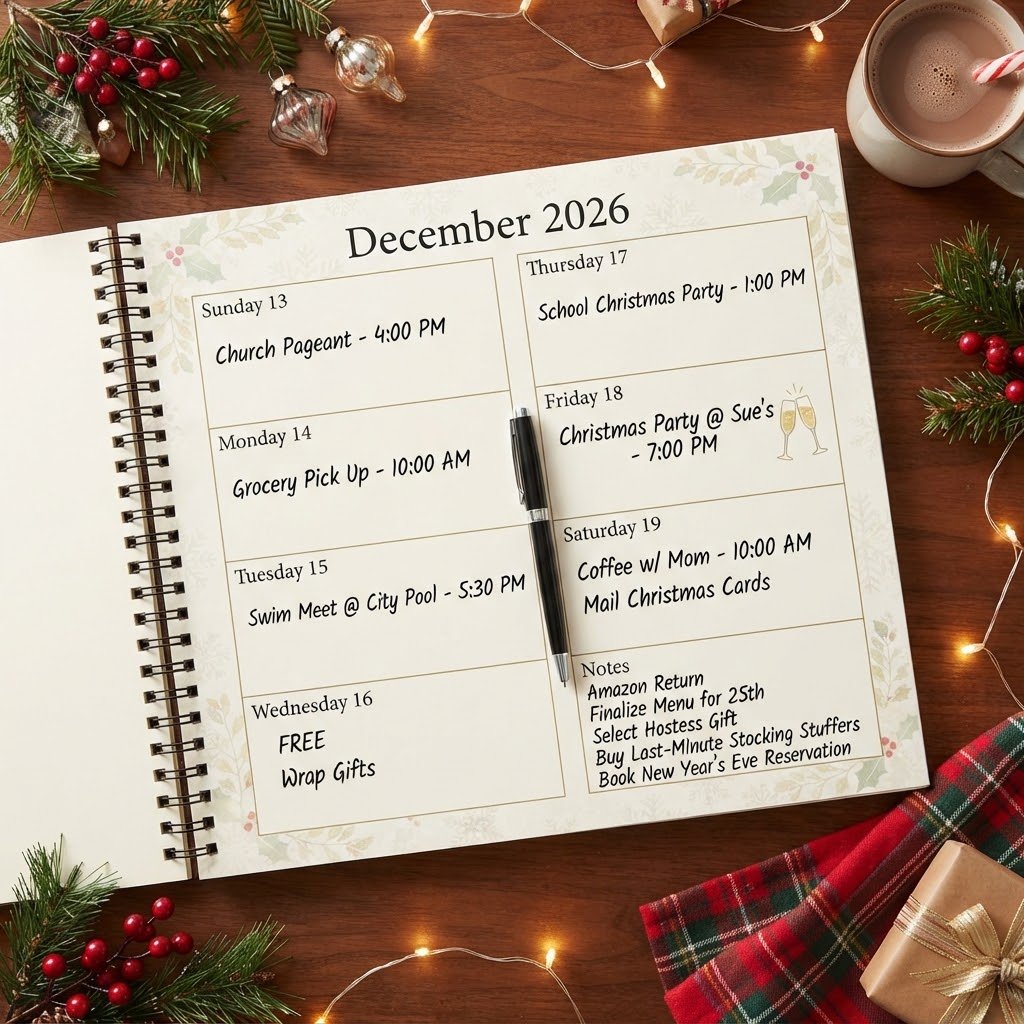
That leaves room for the other day to actually be ours—for baking cookies, watching a movie, doing nothing in particular, or simply handling the ordinary things that still need to happen.
It doesn’t solve everything. There are years when our schedule is complicated enough that even that feels tight. But it gives us a starting point. We don’t have to evaluate every invitation from scratch. We already know one of the ways we protect our household’s capacity.
Your rule may look different. Maybe it’s a protected evening each week. A spending limit decided before the shopping starts. A limit on how many things you’ll host. Or simply a rule that you don’t commit until you know what your household’s schedule actually looks like.
The specific rule matters less than having something in place that helps you protect the capacity you’ve already decided matters.
Know What Your Household Can Carry
The goal isn’t to make your holidays smaller. It’s to make room for the parts of the holidays you actually want to enjoy.
Your household’s capacity will change from year to year, and sometimes from week to week. What worked last Christmas may not work this one. What you wish you could say yes to may not fit alongside everything else you have already chosen to carry.
That doesn’t mean you care less. It means you know what your household can actually do. And there’s no need to apologize for that. Good boundaries aren’t about deciding what matters less. They’re about deciding what you have room to carry — and then being willing to let that decision stand.
Because the goal isn’t to get everything into the holiday season. It’ to enjoy your holidays.