I don’t think every family needs a weekly family meeting.
That doesn’t mean I don’t believe in family meetings. There are times when sitting everyone down around the table—or gathering everyone on the couch—is exactly what a family needs. When something significant is changing, when a decision affects everyone, or when you need to make sure everyone understands what’s happening, a shared conversation matters.
But most of family life is made up of smaller moments: a schedule changes, a child needs a ride, someone is struggling with homework, an opportunity comes up at school, or you realize something isn’t working quite the way it should.
“There’s a school dance Friday. Do you want to go?”
“Tryouts are Tuesday. Can you pick me up later?”
“Your teacher needs volunteers for the class trip. Do you want me to go?”
“You didn’t get your homework turned in on time. What’s going on? How can we help?”
Those conversations don’t need a meeting. They need attention.
And I think that distinction matters more as our kids get older and family life gets busier.

Do You Really Need a Weekly Family Meeting?
Our family has had formal family conversations when we needed them. Sometimes we have a scheduled time when everyone gets together around the couch or table because there is something we all need to know or talk about.
If we’re making a major change to our family life, everyone deserves to hear it together. Moving, a significant change in a parent’s job, bringing a new baby into the family—those kinds of things can affect a child’s sense of security. They deserve more than a passing comment while someone is looking for their shoes.
Other times, the reason for gathering everyone is simpler: everyone needs to be on the same page.
But before turning something into a family-wide conversation, there is one question I find useful:
Who actually needs to know?
If everyone needs to know, gather everyone. If two people need to coordinate something, have that conversation. If one child needs information, encouragement, or help, talk to that child.
It sounds obvious, but it is surprisingly easy to make family life more complicated than it needs to be. We can assume that because something involves the family, everyone needs to be involved in the conversation.
They don’t.
In fact, giving everyone every piece of information can sometimes make it harder for anyone to know what actually belongs to them. Good family communication isn’t necessarily about making sure everyone hears everything. It’s about making sure the right people have the information they need to participate.
Small Conversations Are Still Family Participation
When we talk about family participation, it is easy to think about chores and responsibilities. We’ve spent much of this month talking about how children can take on more responsibility as they grow, how to stop managing everyone’s responsibilities, and how to build systems that allow kids to participate without constant reminders.
But participation isn’t only about the work of running a household.
It’s also about being part of what is happening here.
A child who says, “Tryouts are Tuesday. Can you pick me up afterward?” is participating in the family system. So is the child who says, “I need help with this,” or the child who tells you that something at school is bothering them.
And parents participate, too. We might notice that a child has an upcoming activity and ask, “Do you want to go?” Or we might hear that something is bothering them and ask a question instead of immediately trying to solve it.

These moments may seem insignificant, but they are one of the ways we stay connected to our kids’ lives. We’re paying attention to what is happening in their world, giving them opportunities to tell us what they want, and making it clear that they can bring things to us without needing to make an official announcement.
That’s part of the same shift I wrote about in The Secret to Getting Kids to Help at Home Without Constant Reminders: we want children to become more aware of what is happening around them, rather than relying on a parent to notice and manage everything for them.
That matters.
It also connects to something I wrote about earlier this month: raising kids who can notice what is happening around them and take responsibility for their part in the household. Family participation isn’t just about getting a child to complete a task. It’s about helping them become aware of what is happening around them and understand how they fit into it.
A Voice Doesn’t Mean the Final Say
One of the things that changes as children get older is the kind of participation we ask of them. When our kids were younger, there were plenty of decisions we simply made for them. As they’ve gotten older, we’ve started asking more questions.
Glasses or contacts? What do you want to wear on the first day of school? What do you need for this activity? What’s going on with your homework? How can we help?
Sometimes the children get to make the decision. Sometimes we make it together. Sometimes they have input, but my husband and I have the final say.
That’s an important distinction in our house: having a voice isn’t the same thing as having the final say.
We can ask our kids what they think about a family vacation without handing them the responsibility for planning the vacation. We can give them choices about lunch without making them responsible for feeding themselves for the week. We can listen to what they want and still make the decision we believe is best.
The point isn’t to give children control over everything. It’s to let them experience what it feels like to be a person whose thoughts, needs, and preferences matter.
And that changes as they grow. The goal isn’t to give a five-year-old the same level of input we give a fifteen-year-old. It is to gradually create more opportunities for children to notice, communicate, make choices, and take ownership as they become ready.
Sometimes the Conversation Is the System
This is one of the reasons I don’t think every family needs another chart, checklist, or meeting. Sometimes the system is simply a conversation at the right time.
Your child has a school event coming up, so you talk about it. A responsibility isn’t getting done, so you ask what is getting in the way. A schedule changed, so you tell the person who needs to know. Someone needs help, so they ask. Someone notices something that isn’t working, so they bring it up.
This is particularly important when we’re trying to raise capable kids. The goal isn’t for a parent to become extraordinarily good at remembering everyone else’s lives. The goal is for children to gradually become people who notice what is happening in their own lives, communicate what they need, and understand that other people’s needs matter, too.
That’s the same shift behind Stop Managing Everyone’s Responsibilities: How to Create Family Systems That Actually Work: the goal isn’t to make the parent better at carrying the whole household. It’s to build a household where responsibility can gradually be shared.
And sometimes sharing responsibility starts with something as simple as giving the right person the information they need.
We’ve seen this change in our own kids as they’ve moved into middle school and high school. We still initiate plenty of conversations, but more and more, they initiate them.
“Can you pick me up later?”
“Here’s what I need.”
“I’m thinking about doing this.”
“Can you come?”
Or sometimes, “Do you want to come?”
That last one has changed over the years.
When they were younger, the answer was often assumed: of course I was going. As they got older, the question became, “Do you want me there?” Sometimes the answer was yes. Sometimes it was no. Sometimes they didn’t really have a choice. But even asking the question represents a different kind of relationship. They are growing. We are adjusting how we participate in their lives.
Don’t Underestimate What Happens Around the Dinner Table
This is one of the reasons I’ve been thinking about these small conversations so much lately.
As our kids have gotten older, family dinners have become harder to maintain. There are more activities, more complicated schedules, and more people coming and going. Some meals happen in passing. Some happen in front of a television.
And honestly, that troubles me.
Not because I think every family has to eat dinner together every night. What I miss is the physical togetherness: the lack of screens, the ordinary conversations, and the little bits of information that surface when nobody has planned an agenda.
I learn so much about my kids that way.
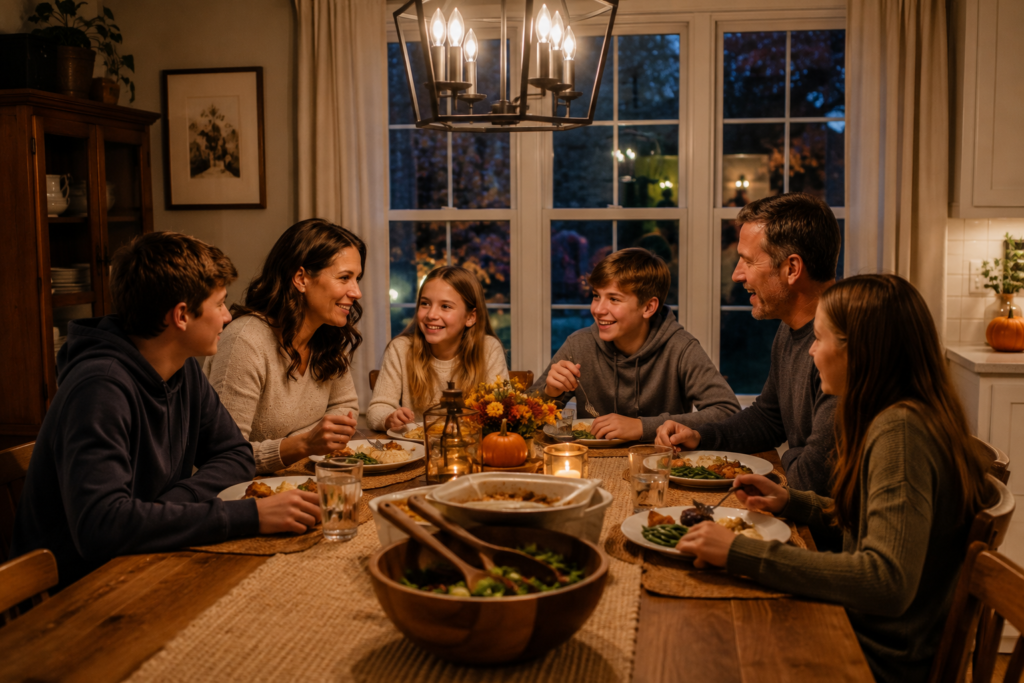
One child will mention something that happened at school, and another will casually respond, “Again?” Suddenly I know that what I just heard isn’t an isolated incident. It is something that has happened enough times that another sibling recognizes the story.I may not need to intervene. I may not even need to ask another question. But now I know.
And then there is the laughter.
I can’t tell you how many family meals have included ridiculous stories, teasing, or some completely unexpected joke that makes everyone laugh. That kind of laughter is pure joy.
You can’t put it on a family calendar. You can’t create a responsibility chart for it. And you certainly can’t manufacture it with a perfectly designed family meeting.
You just have to be together long enough for it to happen.
That’s part of why I think family connection deserves to be treated as something more than another task on the household list. In the middle of busy seasons, we can get so focused on making schedules work that we forget some of the most important things happen in the unscheduled spaces.
I wrote about this earlier this month in How to Create Flexible Family Routines for Busy Seasons. Sometimes the answer to a crowded family calendar isn’t figuring out how to fit everything in. It’s deciding what needs to flex so the things that matter most still have room.
For me, some of those things are these ordinary conversations—and the time together that allows them to happen.
The Goal Isn’t More Meetings. It’s More Connection.
Maybe that’s why I’m less interested in whether a family has a formal meeting every week and more interested in whether the people in that family have ways to talk to one another. A family meeting can be a wonderful tool. We use them when the situation calls for one. But ordinary family life needs ordinary conversation, too.
The child who needs to tell you something doesn’t need to wait until Sunday at 7:00. The parent who notices something doesn’t need to make an announcement to the entire household. And a child shouldn’t have to create a crisis before they feel like they have permission to bring something up.
The conversations can happen while you’re making breakfast, driving to practice, sitting on the edge of a bed, walking through the kitchen, or—when schedules allow—around the dinner table.
The important thing is that there is room for them.
This is really the next step in what we’ve been talking about all month. Family participation isn’t just getting children to contribute to the work of the household. It’s helping them understand that they belong to the household.
They have responsibilities here. They have a voice here. They can ask for help here. They can notice something isn’t working and say so. They can tell us about the good things, the hard things, and the completely ordinary things happening in their lives.
And when something big happens, we stop and make room for everyone. We don’t need a meeting for every little thing. We just need to keep talking. And maybe, as our kids get older and our family life gets busier, I need to get a little better at making sure those small conversations still have a place to happen.