There is no shortage of advice about routines.
Wake up at 5:30. Exercise. Journal. Make your bed. Drink water. Meditate. Read ten pages of a book. Follow the same order every single day.
The underlying message is clear: if you can just find the right routine, everything else will fall into place. But if you’ve ever tried to apply that advice to a busy household, you already know the problem. Real life doesn’t happen in the same order every day.
One child wakes up cheerful, another wakes up hungry, and a third can’t find a shoe. The dog needs to go out. Someone remembers a permission slip as you’re walking out the door. Your morning meeting starts earlier than usual. Suddenly, that carefully planned routine unravels before breakfast.
For years, I assumed the problem was that I wasn’t disciplined enough. Now I think the problem was the routine itself. The best household routines don’t tell you what to do first. They make sure the important things happen, regardless of what order the day unfolds.
If you’ve read my article on building household systems, you’ll recognize this same idea. Good systems aren’t about controlling every moment of the day—they’re about making everyday life work with less effort and less stress.
The Difference Between Rigid and Reliable
When we think about routines, we often picture a list.
- Get dressed.
- Eat breakfast.
- Brush teeth.
- Pack your backpack.
- Put on your shoes.
That works well…until it doesn’t.
Maybe one child wakes up starving and wants breakfast immediately. Another isn’t hungry until ten minutes before it’s time to leave. One likes to get dressed first. Another wants to stay in pajamas until the last possible minute.

Why create conflict over something that doesn’t matter?
In our house, there are a few non-negotiables before school.
You need to be dressed. You need to have eaten breakfast. Your teeth need to be brushed. Your backpack needs to have what you need for the day. How you get there is largely up to you.
The goal isn’t to control the order. The goal is to make sure the outcome happens.
I’ve found that children are much more willing to take ownership of a routine when they have some say in how they accomplish it. After all, if they’re old enough to be responsible for getting ready, they’re old enough to decide whether breakfast comes before brushing their teeth.
Stable Transition Points
Over time, I’ve noticed that the routines that actually last have something in common.
They’re attached to stable transition points.
Not the clock. Not the ideal morning. Not everyone behaving exactly as expected. A transition point is simply a moment that naturally happens during the day. Walking in the front door. Finishing dinner. Getting into bed. Waiting for the kettle to boil.
These moments happen whether the day has gone smoothly or completely off the rails.

One of my own routines happens first thing in the morning. While my tea water is heating, I unload the dishwasher. It isn’t because successful people unload dishwashers before sunrise. It’s because the kettle gives me a few uninterrupted minutes that would otherwise be spent standing in the kitchen waiting. That transition point has been far more dependable than trying to schedule “Unload dishwasher at 6:15 a.m.”
Another example is our car keys. With multiple drivers in our family, cars get shuffled around regularly. If everyone left their keys wherever they happened to empty their pockets, we’d spend half our lives looking for them.
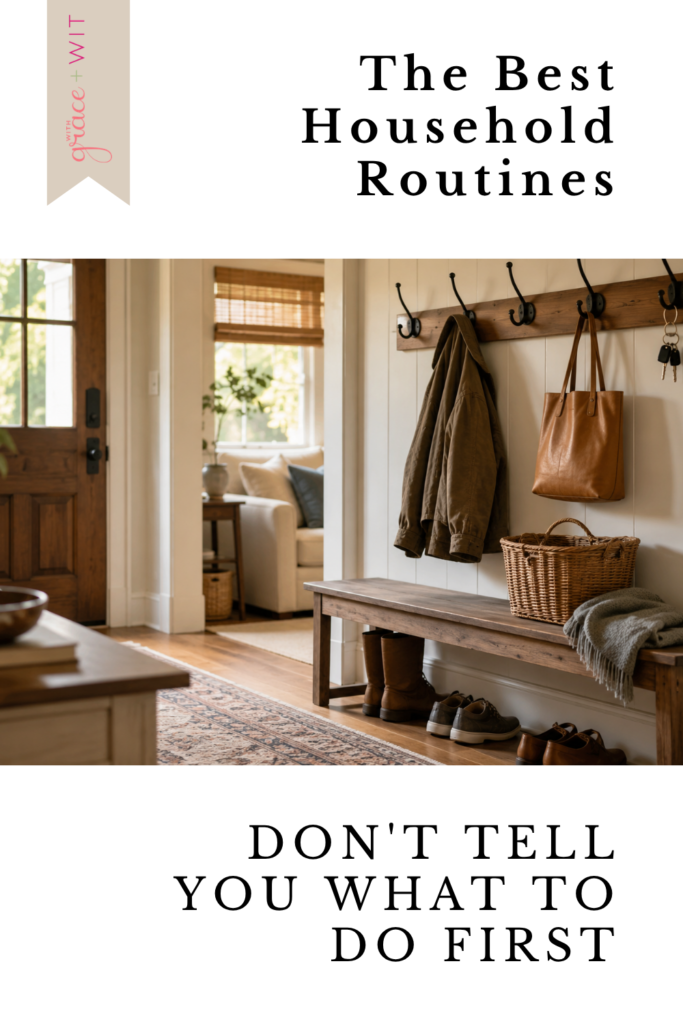
Instead, the routine is simple. When you walk in the door, your keys go on the hook. It isn’t based on remembering later. It isn’t based on motivation. It’s tied to a transition that happens every single time. That one small habit prevents dozens of little frustrations.
Control Isn’t the Goal
I think this is where many household routines quietly fall apart. Sometimes we’re trying to create order. Sometimes we’re just creating control. Those aren’t the same thing.
Control for the sake of control is exhausting. Order exists to make life easier.
If a routine only works when every family member follows the exact same sequence, every day, under ideal conditions, then it isn’t making life easier. It’s creating another thing to manage.
It’s one of the same reasons so many organizing projects fall apart. We often build systems for perfect days instead of ordinary ones. I wrote more about that in Why Most Organizing Fails for Busy Moms, because organization that only works under ideal conditions rarely lasts.
I’ve learned this lesson the hard way. Some of the routines that failed most spectacularly weren’t bad ideas. They were routines I designed for someone else to execute. As parents, it’s easy to think, “Here’s the order that makes sense to me.” But your child isn’t you. One kid packs their backpack the night before because loose ends make them anxious. Another can’t be bothered until the morning and does it just fine in five rushed minutes. Neither approach is wrong. The important thing is that both kids walk out the door with what they need. When we loosen our grip on the order, we often get better cooperation with the outcome.
Some Things Should Stay Time-Based
None of this means schedules don’t matter. Some things absolutely belong on the clock. School starts at a certain time. Work begins when it begins. Appointments don’t wait because our morning was hectic.
In our family, we often tell our children that school is their work. Just as adults are expected to arrive at work on time, children learn that showing up prepared and on time is part of their responsibility.
Time matters. Deadlines matter. Commitments matter.
But many household routines don’t need that same rigidity. The dishes get done after dinner. Sheets get washed once a week. Whoever empties their lunch box puts it straight in the dishwasher, not the counter. Bedtime includes brushing teeth, washing faces, and getting ready for tomorrow. Those routines aren’t floating aimlessly. They simply don’t require an exact minute on the clock to be successful.
That’s an important distinction.
Build for Real Life
I think we’ve accidentally started designing routines for ideal days. Ideal days are quiet. Everyone sleeps well. Nobody spills the milk. The dog doesn’t throw up. No one remembers a science project five minutes before leaving.
Unfortunately, those aren’t the days most of us need help with.
A good household routine shouldn’t disappear the moment life becomes inconvenient. It should survive inconvenience. It should bend without breaking. If someone needs breakfast first, the routine still works. If someone gets interrupted halfway through getting ready, the routine still works. If yesterday was exhausting and today starts a little slower, the routine still works. That’s resilience. And resilience is far more valuable than a flawless morning.
Ask a Different Question
The next time you’re trying to establish a routine, don’t start by asking, “What should happen first?”
Instead, ask a few different questions.
- What absolutely needs to be true by the end of this routine?
- Is there a natural transition point I can attach this to?
- Am I creating order, or am I creating unnecessary control?
- Does this routine still work on an ordinary Tuesday when life is messy?
Those questions have changed the way I think about household systems. Because the purpose of a routine isn’t to impress anyone.
It’s to reduce stress. To lighten the mental load. To teach children responsibility. To create a home that functions well, even when life doesn’t.
If you’re realizing the same frustrating moments keep happening in your home, that’s usually a sign that a decision hasn’t been made or a system hasn’t been built. That’s exactly why I created the Repetition Reset. It will help you identify the household problems that keep repeating—and show you how to create simple systems that make them stop.
The best household routines don’t tell you what to do first. They quietly make sure the things that matter still get done.