Real life isn’t predictable. Your household doesn’t have to be either.
Last summer, our house ran on rhythm. A to-do list with clear expectation for the day. It encompassed both play and chores; order more or less held. This summer, with older kids, we tried something different — looser structure, more autonomy, room for them to manage their own time between sports and overlapping schedules. It was, in a lot of ways, the right call for their ages.
It has also been a summer for the books. Lots of good. Also lots of complaining, all day, every day, from kids who have started to pout if they don’t get their way and don’t love hearing no. My husband and I have had irregular schedules of our own this summer, and everyone — all of us — has been a little on edge. Not because anyone did anything wrong. Because the rhythm is in flux, and a house without rhythm makes everyone re-negotiate everything, constantly.
I don’t want another summer like this one. Which is exactly why I’ve been thinking so much about what makes a rhythm actually hold.
Have you ever noticed that some parts of your day seem to run almost automatically while others require constant reminders, negotiations, and repeated decisions?
Maybe everyone knows to take their shoes off at the door, but getting homework started turns into the same conversation every afternoon. Maybe Monday laundry happens without much thought, but dinner feels different every night.
The difference often isn’t motivation.
It’s rhythm.
When people hear the word routine, they often imagine a perfectly timed schedule where every task happens at exactly the right moment. While schedules certainly have their place, most households don’t stay on schedule for very long. Traffic happens. Practices run late. Someone gets sick. Work meetings change. Life refuses to cooperate.
A household rhythm is different.
It gives your day a predictable flow without expecting every hour to look exactly the same.
Household Rhythms Can Include Schedules
This isn’t an argument against schedules. Some things genuinely work best at a specific time. A young child may have an 8:00 bedtime. School starts when it starts. Work meetings aren’t flexible. Those schedules create healthy boundaries.
But not everything needs to happen by the clock.

Many of the decisions we make every day work just as well — or better — when they’re connected to what comes before or after them instead of a specific time.
Instead of saying: “Homework starts at 4:15.”
You might decide: “Homework happens before screens.”
Instead of wondering when the kitchen should be cleaned, your household simply knows: “We clean the kitchen after dinner.”
The clock matters when it needs to. The rhythm carries everything else.
What Makes Something a Household Rhythm?
Household rhythms usually have three qualities.
- They’re predictable. People know what to expect without having to ask.
- They’re repeatable. The same pattern happens often enough that it becomes familiar.
- They’re flexible. If the timing changes, the rhythm still works.
Our laundry is a good example.
Years ago, I decided each day of the week would have a different laundry focus. Mondays are sheet day. Before the kids leave for school, they strip their beds. Some Mondays I start the first load at eight o’clock. Other Mondays it’s much later. The exact time doesn’t matter. The rhythm does.
No one has to wonder what gets washed first. I rarely have to remind the kids anymore because they’ve done it enough times that it’s simply what Monday means in our house. That’s the goal. Not perfection. Predictability.
Four Household Rhythms Worth Thinking About
Every household will look different, but most days naturally move through a few familiar transitions.
Morning
Morning rhythms answer the question: “What needs to happen before we leave?”
School, work, lunches, personal hygiene, breakfast. On a good morning, everything goes smoothly. On a bad one — someone slept in, breakfast took thirty minutes longer than it should have, hair-brushing becomes a negotiation, and we’re late — drill sergeant mom takes over. Those are also the mornings you can bet I’ve left my tea, hot, in the travel mug, on the counter. Because on a morning where I’m running through everyone else’s to-do list, mine doesn’t make the cut.
That’s the real value of a morning rhythm: it’s not just there to manage the kids. It’s supposed to leave enough room for you to remember yourself too.
Daytime
This rhythm often gets overlooked because everyone is scattered between work, school, errands, or home. Even here, small patterns help. Maybe paperwork gets handled before lunch. Maybe you reset the kitchen after breakfast. Maybe one load of laundry gets started before moving on to the next task. These aren’t rigid rules — they’re simply the way your day tends to flow.
Coming Home
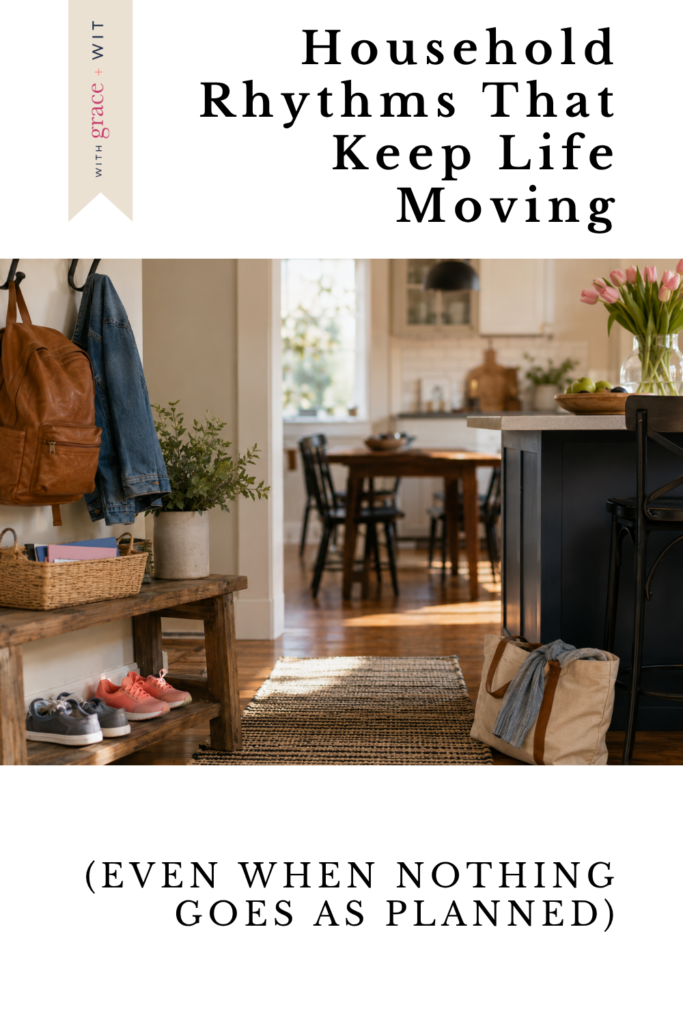
This is often when household stress peaks. People arrive home hungry, tired, carrying backpacks, sports equipment, work bags, and everything else the day collected. A simple rhythm removes some of the uncertainty — shoes away first, backpacks emptied before free time, homework before screens. It doesn’t have to be complicated. It just needs to be understood.
Evening
Evening rhythms tell everyone that the day is winding down. In our house, bedtime is still a scheduled time, and that clear boundary makes life easier, especially with younger kids.
But not every evening rhythm is about winding down or managing behavior. Some are just a reward for getting older. Our middle schooler has an hour at bedtime the younger one doesn’t get yet — a slightly more grown-up show, or a game, while the house quiets down around them. It’s not a big production. But it’s theirs, and they know it’s theirs, and it’s become its own small rhythm of being trusted with something new.
Why Household Rhythms Lower Stress
One of the biggest benefits of a household rhythm is that it answers questions before they’re asked. Children stop wondering what comes next because they’ve experienced it enough times to know. Adults benefit just as much — instead of asking yourself “should I start laundry today?” or “when am I supposed to clean the kitchen?”, those decisions have already been made. That doesn’t mean every day runs smoothly. It means fewer decisions compete for your attention, and your brain has more space for the unexpected because the ordinary no longer requires so much thought.

You Don’t Need More Rules
If your household feels chaotic, resist the urge to create a more detailed schedule. Instead, look for one place where people repeatedly ask the same question — “when do we do homework?”, “whose turn is it?”, “what happens after dinner?” That’s often where a rhythm is missing.
You don’t need to solve your whole household at once. As I look ahead to fall, that’s exactly what I’m doing — not overhauling everything, just finding the one or two places where the questions keep repeating. One predictable pattern is enough to make tomorrow feel a little easier than today. Because real life will never go exactly as planned. But when everyone understands the flow of the day, your household can keep moving anyway.
Predictability creates peace more than precision.