There are certain things that make fall feel like fall in our house. Cooler mornings. Shorter evenings. Cinnamon tea—not pumpkin spice. And the unmistakable feeling that the household has shifted into a different gear.
Summer is forgiving in ways that fall isn’t. If a child takes an hour to get dressed, it may not matter. If lunch happens at noon one day and two o’clock the next, nobody is necessarily inconvenienced. There is usually a little more room for everyone to move at their own pace.
Then September arrives, and suddenly 7:15 matters.
The school bus matters. Practice matters. Homework matters. Dinner matters. The hour between getting home and getting to the next activity matters. By the time everyone needs to be showered and ready for bed, the day can feel surprisingly full.
And this year, we have left behind the years when everyone naturally woke up at 6:30 and was eager to get moving. Now we have teenagers and pre-teens who would happily sleep later, combined with school schedules that don’t always agree. That doesn’t mean we need a better alarm clock or a stricter morning routine. It means the way our household worked a few years ago no longer necessarily fits the household we have now.
This isn’t a checklist. I’m not going to hand you a system to install. What follows is more like a way of looking—at your calendar, your routines, and your own frustration—so that when the holidays actually arrive, you’re not surprised by things you could have reasonably seen coming.

What Does Your Household Need Now?
Fall is a natural point to ask this question because so much has already changed.
The school year has started. Summer activities are winding down or changing. Sports and extracurriculars are filling the calendar. The days are getting shorter. The holidays are still down the line, but they’re close enough that you can see the shape of them coming.
It is tempting to respond to all of this by trying to become better at managing it. I’ve done that.
When something isn’t working at home, it is very easy to try a solution. If that doesn’t work, try another one. Get up earlier. Make a new schedule. Give more reminders. Create a new routine. Reorganize the thing that keeps getting left out.
Sometimes those changes help. But sometimes you can keep changing the solution without ever asking whether you’ve correctly identified what changed.
A household can be perfectly functional in one season and need an adjustment in another.
That is why I like beginning with observation rather than organization.
What is different about your household now? What is taking more time than it used to? Which parts of the day feel compressed? Where are you finding yourself frustrated over and over again?
You don’t have to fix all of those things. You simply need to notice them.
Look at the Hours That Have Become Harder
For our family, one of the biggest pressure points is the stretch between roughly 3:00 and 8:00 p.m.
That is where homework, sports, screens, dinner, showers, transportation, and getting ready for the next day all compete for the same few hours. It is also a time when everyone is tired and hungry, which does not exactly make household logistics easier.
Screen time is the piece of this stretch I fight with every fall, and I haven’t fully solved it. I’d rather my kids fill those forty-five minutes with almost anything else. But given the choice, all of my kids will pick a screen, and the reality of a tired, hungry after-school hour doesn’t always leave room to fight that as hard as I’d like to. The real issue is what happens in the unstructured gap before that choice gets made.
A kid finishes homework. A sibling is at practice. There are forty-five minutes with nothing structured in them, and the TV is the easiest thing standing in that gap. The question becomes, “Then what?”
What the rules actually are—is homework really done, is a sibling’s absence a reason to bend them, does it change once someone’s old enough to negotiate—gets renegotiated constantly, especially with a middle schooler who is testing exactly how firm any rule really is.
I don’t have this fixed. I’m not sure it’s the kind of thing that gets fixed once and stays fixed. Some friction gets solved and stays solved. Some of it just gets managed again every season, with a kid who is a little older each time you have the conversation.
The same unevenness shows up in the mornings, though the friction there isn’t really about logistics.
In our house, one child gets up, gets dressed, eats, and is out the door without much involvement from me. Another needs to be asked twice to brush her hair, sighs at being reminded to eat breakfast, and treats the whole process like something being done to her rather than by her.
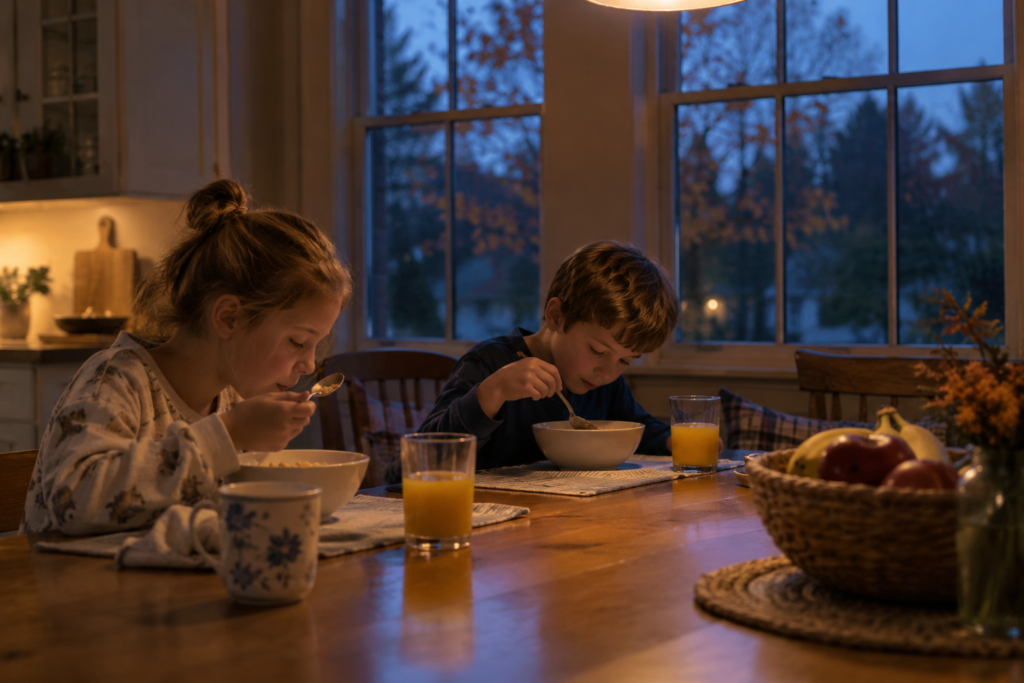
I used to think the goal was getting all kids through the same routine. It isn’t. The goal is getting the kids out the door on time and reasonably intact—including me. That means I’ve mostly stopped trying to manage the mood and started just managing toward the outcome. It’s not the how. It’s the final product.
They don’t need the same morning. They do need to understand the framework: this is when we leave, these are the things that need to happen before then, and this is what each person is responsible for.
That is what a household rhythm really is. It isn’t necessarily a detailed schedule that everyone follows in exactly the same way. It is a shared understanding of how the household operates.
As the season changes, ask yourself whether your family still understands that rhythm. And pay attention to your own reactions. If you find yourself frustrated by the same thing every day, or giving the same reminder over and over, don’t automatically assume you need to try harder.
Sometimes frustration is information. It may be telling you that the way the household is currently set up no longer fits the people, schedules, or demands you’re asking it to handle—or it may just be telling you this particular thing isn’t going to be solved this season, and that’s fine too.
Look Ahead Before the Calendar Fills
The other reason I like taking this look in early fall is that the next few months are predictable, even if the details aren’t filled in yet. Halloween, Thanksgiving, and Christmas arrive one after another. School programs, activities, travel, family gatherings, and birthdays stack on top of them, and the end of the year can become one long stretch of commitments.
Years ago, when I had four kids at home, I set a rule: Halloween costumes are settled by October 1st. Not perfected, not purchased in full—settled, so we know what we’re working with.

I didn’t know yet when the school events or other Halloween plans would fall. But I knew that if I waited for every detail, I’d be trying to find a costume after everything had sold out—or paying a premium for whatever was left. So the rule wasn’t really about Halloween. It was about not letting an unknown detail block a decision I was already capable of making.
I only have one child to dress for Halloween now. I still use the rule anyway.
The same logic applies to birthdays. Good etiquette says party invitations should go out four to six weeks ahead. I’m lucky if I manage three. This year, I’ve already decided the date—or the backup date—but I can’t act on it yet because it depends on when a work holiday party lands, and that always falls the same weekend. So I’ve stopped waiting on the whole decision. I’ve made the part I can make, and I’m only waiting on the one piece I actually don’t control. The moment that clears, I move.
If you find yourself stuck on a decision this fall, it’s worth asking whether you’re actually stuck—or whether you’ve just been treating one unknown detail as a reason to delay everything.
Gift buying is where I’ve loosened up, not tightened.
One year I bought a Lego set in September, confident it was a safe early pick—and by December, it wasn’t the one my kid actually wanted. It wasn’t even close. Buying early doesn’t mean predicting exactly right, and for anything trend-driven, it probably won’t.
So now I pay attention to which categories actually benefit from buying early.
Stocking stuffers are one of them. When back-to-school things go on clearance, I look for fun pens, erasers, and little things I think the kids will like at a fraction of the cost. I also start bargain hunting for beauty items when I see a good sale. These aren’t things I want to be shopping for in December, and they add up quickly. Picking them up gradually takes a surprising amount of pressure off the holidays.
For other gifts, especially anything trend-driven, I deliberately leave the decision until later, when I actually know what’s being asked for.
The point of looking ahead isn’t to move Christmas into September. It’s to make sure September is doing some of the thinking that would otherwise land on you in November.
That might mean talking with your spouse about travel dates. It might mean identifying a tradition that’s become more work than it’s worth. It might mean noticing the entryway needs a better place for everyone’s fall gear before the weather turns.
Or it might simply mean deciding a date you can’t act on yet—so you’re ready the moment you can.
Look for the Small Friction You Already Know Is Coming
Sometimes preparing for a busy season is remarkably unglamorous.
One year, I noticed we had a recurring problem when we decorated the Christmas tree. An ornament or two had broken over the year in storage. A Santa hat had come off a flamingo. A bow had been knocked loose. Something needed a tiny repair before it could go back on the tree.
And inevitably, we didn’t have any super glue.
I would think, “I’ll pick some up.” Then the season would get busy. The broken ornament would get set aside. February would arrive, and I’d still have a little broken piece sitting somewhere because I hadn’t gotten around to buying the thing that would take about thirty seconds to fix.
Now I have a calendar reminder in early November to check our super glue stock and add it to the shopping list if we need it.
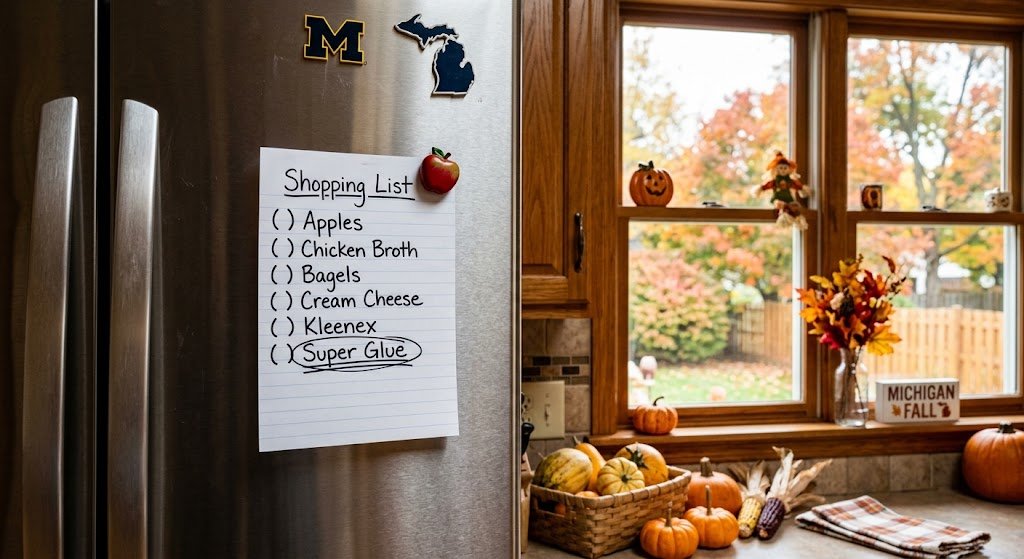
That’s it. It isn’t a holiday system anyone would put on Pinterest. But it solved a recurring piece of friction before it happened.
That is often what useful household planning looks like. You aren’t trying to anticipate every possible problem. You’re noticing the small things that have a history of becoming problems, and giving them a little attention while you still have room to do so.
Preparation Doesn’t Mean Doing Everything Early
This distinction matters because I don’t think we need to turn fall into another season of productivity. Preparing for the holidays doesn’t mean buying all your gifts in September, planning every meal through December, or creating a color-coded master plan for the next four months.
It means looking at what is coming and deciding what actually deserves attention now—and what can genuinely wait.
Some things can be decided early. Some things can be purchased early. Some things need other people’s input. Some things are better left until later, even when waiting feels uncomfortable.
The point is not to move Christmas into September. It’s to make sure the thinking gets a head start, even when the doing has to wait.
Don’t Turn This Into Another Project
Give yourself thirty minutes. Look at the calendar from now through the end of the year. Think about what has changed in your household since last fall. Notice where you’re already feeling friction. Remember what caused trouble last year.
Then ask a few simple questions:
- What is different now?
- What is already harder than it should be?
- What will become more difficult as the calendar fills?
- What can I decide now, even if I can’t act on it yet?
- What small friction do I already know is coming?
- And what does not need to be fixed at all?
That last question is important. Not every inconvenience is a system that needs to be redesigned. Not every messy room is a household failure. Not every busy week requires a new routine. Sometimes you simply need to recognize that the season is different and make one small adjustment.
The Goal Is Resilience, Not a Perfect Season
The holidays are going to be busy. People will be tired. Plans will change. Someone will forget something. An activity will run late. A string of lights will go out.
A calm holiday season isn’t one where none of those things happen. It is one where your household can absorb them without every unexpected thing becoming an emergency.
That is why the work you do in early fall matters. Not because your house needs to be perfectly organized before the holidays arrive, but because you still have enough space to notice what your household is going to need.
You don’t have to get ahead of everything. You just need to look ahead far enough to see where the friction is likely to come from—and make a few thoughtful adjustments while there is still room to make them.
The calmest seasons aren’t created because we suddenly become better at handling everything. They’re created because we noticed what was coming and gave our households a little more support before it arrived.