The kitchen is clean. Counters wiped. Dishes done. Backpacks hung by the door instead of dropped in the middle of it. You did the thing.
And yet.
Standing there in the quiet of a supposedly clean room, your brain is running a background program that never quite shuts off. The basement is wrecked. That pile of papers I moved to the office — I didn’t sort it, I just relocated the problem. There’s a permission slip somewhere. Did anyone feed the dog? I never responded to that email from the school. The permission slip — is it due tomorrow?
The kitchen is clean. Your brain is not.
This is the paradox no one talks about enough: a tidy home is not the same as a quiet one. And if you’ve ever stood in a room you just cleaned and still felt completely overwhelmed, I want you to know — you’re not doing it wrong.

“Loud” Isn’t About Volume
When I talk about a loud house, I don’t mean noise in the traditional sense (though with four kids, I know that kind too). I mean the kind of loud that lives entirely in your head.
Mental noise. Cognitive clutter. The invisible hum of a home that never fully lets you rest.
It shows up as visual clutter — the stuff your eyes land on and your brain registers as unresolved. The basket of laundry that’s been clean for three days but hasn’t been put away. The pile of shoes that multiplies at the back door. The charging cables draped across every surface like vines.
It shows up as unfinished decisions — every item in a “to be sorted” pile is a small task you’re keeping in your memory. The Amazon return. The library book. The thing from the garage that belongs to your neighbor.
And it shows up as micro-responsibilities — the small, recurring duties that don’t have a clear owner or a clear end. Who’s checking that the fridge has stuff for lunches tomorrow? Who noticed the toilet paper is almost out? Who knows that Wednesday is a late pickup day?
These inputs don’t announce themselves. They accumulate. Quietly, relentlessly, they stack up until your brain feels full even when your counters are empty.
The Invisible Inputs
Here’s the thing about the mental load of a home with kids — it doesn’t shrink as they get older. It just changes shape.
When they were little, it was nap schedules and snack packs and childproofing. Now it’s:
- The group chat with your kid’s friend’s mom that you need to respond to sometime this week
- The Amazon return that’s been riding around in your trunk for three weeks because you never seem to pass a UPS store or Whole Foods when you actually have time to stop
- The doctor’s appointment you rescheduled over the phone and forgot to put on the calendar — because the calendar and your phone are now one and the same, and somehow that makes it easier to lose things
- The permission slip you signed but aren’t sure made it back into the right backpack
- The thing your kid mentioned needing for a project — casually, in passing — and you keep forgetting to write it down. They’ve reminded you three times now.
- The follow-up email from school that requires a decision you’ve been putting off because the deadline feels far away until it isn’t
- The dish that’s been soaking in the sink for 24 hours because no one wants to clean it
- The college visit your 17-year-old wants to take “this spring” that you haven’t actually looked into
- The password someone needs for something
- The conversation you keep meaning to have with one of your kids that never finds the right moment
None of these are big. Any one of them, handled, would take ten minutes. But they don’t live in a list — they live in your nervous system. They surface at random. At 2am. While you’re trying to enjoy a quiet cup of coffee in a clean kitchen.
These are open loops. Tasks, decisions, and responsibilities that have been started — or just noticed — but not resolved. And every open loop is a small tax on your brain.
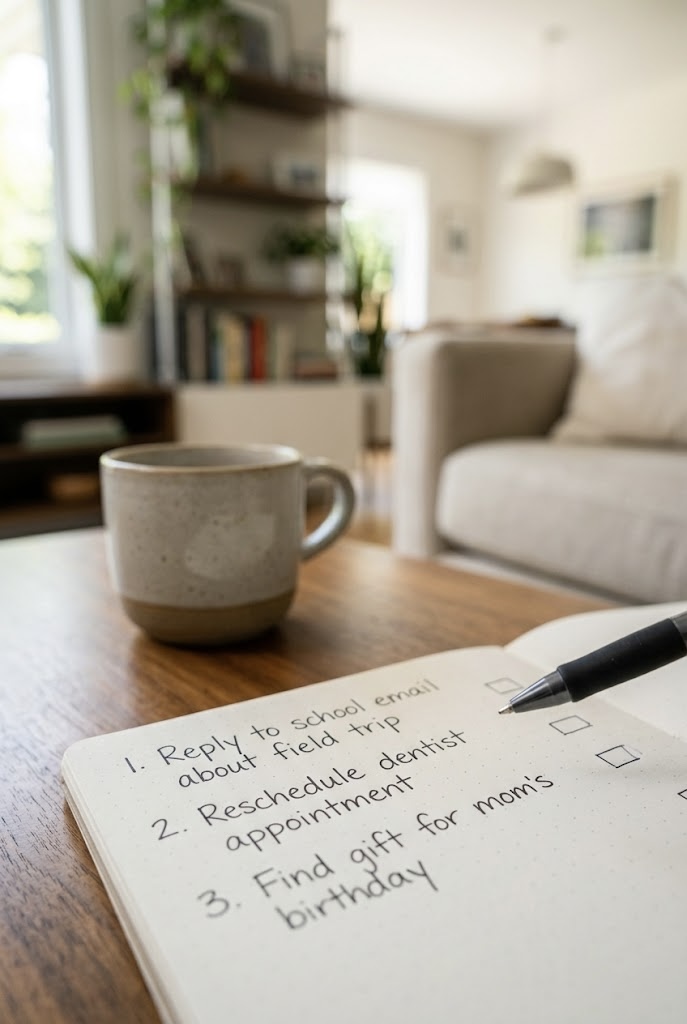
Pause here for a second. Before you keep reading, take 60 seconds and do a quick mental scan. What’s running in your background right now? What are the three things your brain won’t stop quietly worrying about? You don’t have to solve them. Just name them. Naming them is the first step to closing them.
Why Clean Isn’t Enough
Here’s the hard truth: cleaning resets surfaces. It does not reset systems.
When you wipe the counters, you’re solving a visual and health problem. When you put the toys away, you’re solving a spatial problem. And those things matter — I’m not here to tell you that tidying up is pointless. A clean space genuinely helps. But it’s a temporary solution to a structural problem.
Because the noise in your home isn’t coming from the mess. It’s coming from the conditions that create the mess. And those conditions are still there, fully intact, the moment you put the sponge down.
The laundry will come back. The papers will pile again. The backpacks will land on the floor by Thursday. And with them comes every open loop, every unfinished decision, every item that doesn’t have a home — ready to reload and start the cycle again.
I’ll be honest — I clean when I’m overwhelmed. It feels productive. It looks like progress. But more often than not, I’m wiping counters to avoid the harder work of sorting the pile, scheduling the appointment, or making the decision I’ve been putting off. Cleaning gives me the feeling of doing something without actually closing any loops. And then I wonder why, an hour later, I still feel behind.
We keep cleaning hoping it will finally feel like enough. But cleaning without systems is like bailing water without fixing the leak. You get a dry boat for a little while, and then you bail again.
This is not a failure of effort. Most parents I know — especially those managing a household with teenagers — are working incredibly hard. The exhaustion is real. The overwhelm is real. And it has very little to do with how clean your house is.
What It Actually Means to Quiet a Home
A quiet home is not a spotless one. A quiet home is one where your brain doesn’t have to hold so much.
Think about what it feels like when everything has a place — not just a shelf, but a logical home it returns to automatically. When your kids know where their stuff goes and it actually goes there. When a decision has been made once and doesn’t have to be made again every single day. When the routines are predictable enough that your brain can release them and stop running them in the background.
That is quiet.
It’s not a magazine spread. It’s not perfect. It doesn’t mean your house is always clean. It means your house has systems that catch things before they become open loops. It means fewer decisions are embedded in the environment waiting for you to make them.
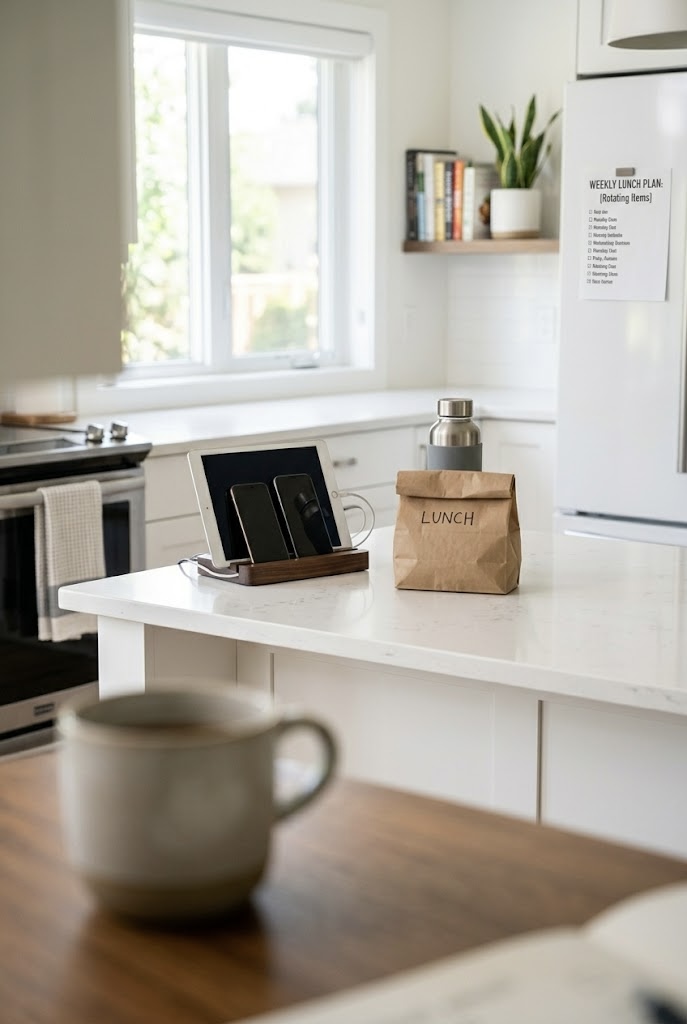
Here’s a small but powerful example. For years, every morning in our house was a low-grade scramble — where’s my phone charger, what’s for lunch, I need money for something today. Every morning, those were decisions made in real-time, under pressure, while half-asleep. We weren’t behind because we were disorganized people. We were behind because we hadn’t closed those loops in advance.
When we built defaults — a charging station, a rotating lunch plan, a weekly check-in — those decisions stopped living in our heads. They were made once. The morning got quieter. Not because we cleaned the night before. Because we eliminated the decisions.
This is the shift. From cleaning your home to designing it.
Practical Shifts That Actually Work
These aren’t dramatic overhauls. They’re small structural changes that reduce the number of decisions your environment demands from you.
Close loops daily — not perfectly, but intentionally. Before bed, do a quick “loop check.” Not a full tidy. Just: what’s open that I can close in the next five minutes? Reply to that text. Move the return to the front seat so you actually drop it off. Write down the thing that’s been spinning in your head. Incomplete loops left open overnight compound. Small ones closed before bed don’t. (If you want a more concrete version of this, the nightly reset system I use in summer applies year-round — the concept of “closing duties” is the same idea.)
Reduce your “in-progress” zones. Every household has them — the counter where things land “for now,” the chair in the bedroom where clothes go that aren’t dirty but aren’t put away, the area by the back door that becomes a staging ground for everything unresolved. These zones feel like organization, but they’re actually just deferred decisions in a pile. Pick one zone this week. Give everything in it a real home or a deadline. Then protect that surface. The goal isn’t zero in-progress zones — it’s fewer.
Create frictionless defaults for the things that repeat. Same drop zone for backpacks. Same shelf for permission slips (they go there the second they come home — no exceptions). A rotating meal plan that removes the daily “what’s for dinner” decision. A charging station in one location. A family calendar that everyone actually checks. Defaults don’t require discipline to maintain because they’re not choices anymore — they’re just what happens. That’s the point.
Give the mental load a place to live outside your head. For those of you managing teenagers who are approaching some level of independence — this one matters even more. A shared family task list, a whiteboard in the kitchen, a Sunday night five-minute check-in where everyone surfaces what’s coming in the week ahead. When the loops live somewhere outside your brain, your brain gets to rest.
The Brain That Gets to Stop
I’ve had kids in every stage — the tiny ones who need everything done for them, and the near-adults who need you in entirely different and sometimes harder ways. And I can tell you that the mental load doesn’t automatically ease with time. You don’t graduate out of it.
What does ease is the noise — when you stop trying to manage it all in your head and start putting it somewhere it can actually be managed.
Peace in a home with kids isn’t found in spotless counters. I’ve had spotless counters. I’ve also stood next to them feeling like I was drowning. Peace is found when your brain can actually set something down. When the systems in your home are doing some of the holding. When you walk into your kitchen at the end of a long day and you don’t immediately start scanning for what you’re forgetting.
That’s the quiet I’m talking about. And it’s available to you — not when your house is finally perfect, but when it stops demanding so much.
One thing to try this week: Pick one recurring open loop in your house — something your brain keeps quietly carrying — and close it. Not all of them. Just one. Give the thing a home, make the decision, write it down somewhere it won’t get lost. Then notice what it feels like to not be holding it anymore. That’s the feeling we’re after. Start there.