Keeping the emotion out of budgeting can be hard — but it can be learned. That one sentence took me years to really understand, and it changed the way my husband and I talk about money, manage our household, and sleep at night.
If you’ve been following along here, you know I budget weekly using a three-bucket system. I’m not here to walk that back. Weekly budgeting is genuinely useful, and for a busy household, it keeps the day-to-day from getting away from you. But for a long time, even when I was doing the weekly work faithfully, something still felt off. Getting out of that paycheck-to-paycheck feeling was harder than it should have been. The weekly view was doing its job — I just couldn’t see the bigger picture from where I was standing.
That’s where the monthly reset comes in. It’s not a replacement for weekly habits. It’s the zoom-out moment that makes everything else make sense.

When Weekly Isn’t Enough
Here’s a specific example that might sound familiar. If you’re on a salaried or regular pay schedule, you probably know about the occasional three-paycheck month. It feels like a bonus, a windfall — and it’s tempting to treat it like one. But what often gets missed is what comes right after. That third paycheck shifts your cycle. A paycheck that normally landed before the 7th of the month is now landing on the 14th. That one-week gap has to be covered by something, and if you already mentally allocated that extra check toward summer clothes shopping or a home project, you may be short without realizing it until it’s too late.
A weekly budget won’t catch this on its own. You’re looking at the week in front of you, not the month behind and ahead of you at the same time. The monthly reset is what gives you that wider view.
This was also where things clicked for my husband and me. We needed a shared framework — something we could both look at — to have productive money conversations instead of stressful ones. We tried paid apps with automatic categorization, but spent more time approving transactions and reconnecting broken account links than actually budgeting. We tried managing everything in a calendar, writing every payment in by hand. That was tedious, but honestly? The visual of when money was coming in and going out was genuinely useful in those early conversations. It was a starting point, even if it wasn’t our long-term system.
Eventually we landed on a spreadsheet that maps out cash flow for the entire year. We can look at the current month zoomed in, or scroll ahead to see what September looks like — knowing we’ll refine it when we get there. The tool matters less than the practice. What matters is having something you both understand and can look at together.
What a 30-Minute Monthly Reset Actually Looks Like
The reset itself is something I do solo. It’s not a household meeting — it’s more like a bookkeeping session that sets the table for our bigger-picture check-in together. And now that our system is established, it takes 30 minutes or less. (December is the exception — planning the new year deserves a little more time, and I give it that without guilt.)
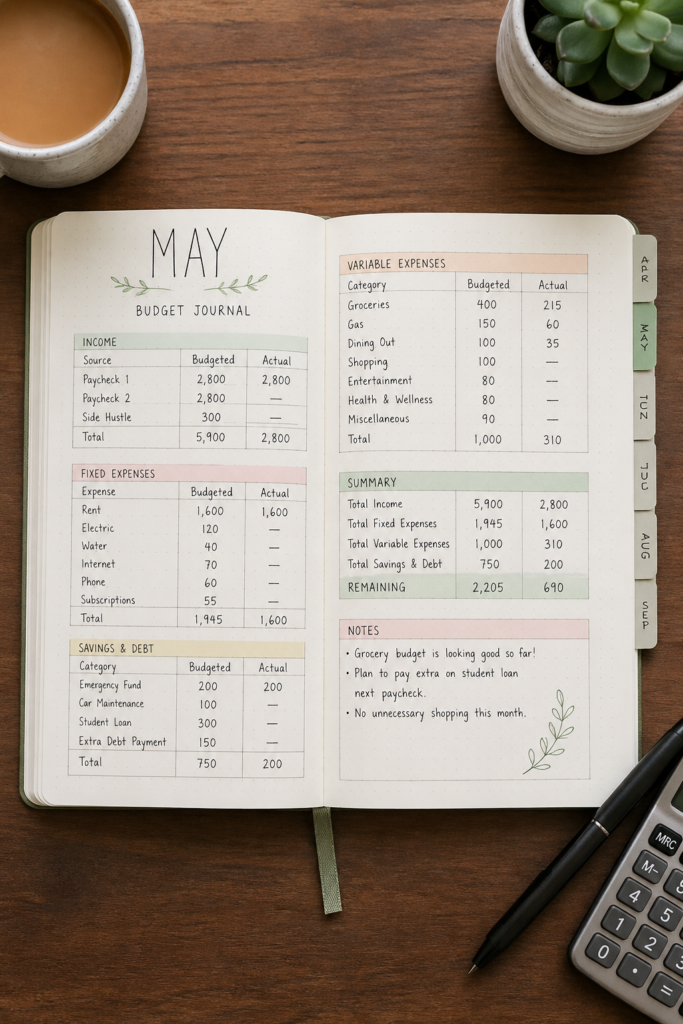
Here’s what I actually do:
I start by reconciling my accounts. I check that my income is accurate — I intentionally budget slightly less than what I expect to receive, which builds in a small buffer without requiring a separate savings calculation. I log any extra income that came in. I make note of any unplanned spending. Then I confirm that everything that was supposed to be paid was actually paid.
From there, I look ahead to next month. What bills are coming, and when? What’s coming in, and when? Are there any surprises on the horizon — an irregular expense, a subscription renewal, a month where the timing is tighter than usual?
One thing I’ve let go of is categorizing every single transaction. I don’t need to know my yearly utility spend as a single number — and even if I did, how do you define that category? Gas and electricity? What about water, sewer, and trash? Modern utility company apps let me log in and see my monthly spend for the past year directly, so I don’t need to recreate that data. What I do track is the seasonal pattern. Gas and electricity swing significantly between summer and winter. Understanding that swing lets me forecast accurately instead of dividing an annual total by twelve and hoping for the best. During my reset, I update my budgeted numbers with the actual bills as they come in, so the forecast stays grounded in reality.
Catching What the Weekly View Misses
The monthly reset isn’t about analyzing every transaction. It’s about noticing things early enough to actually do something about them.
The paycheck timing shift is one example. Seasonal spending creep is another. And then there’s Christmas.
I’ll be honest — Christmas sneaks up on me every year, even when I think I’ve planned for it. The gift budget is the easy part. It’s everything else: the extra groceries for holiday gatherings, the white elephant gift for a party you forgot was happening, the teacher and bus driver gifts, the two new strands of lights because the ones you thought you had are burnt out. No amount of planning fully eliminates this category of expense. What the monthly reset does is make sure you see December coming with enough runway to absorb the extras, rather than discovering them mid-month when your options are limited.
There’s a specific feeling that comes with catching something before it becomes a problem. It’s not dramatic — it’s quiet. A sense of I saw that coming and handled it. Over time, as you start to understand the rhythms of your own finances, that feeling becomes something bigger: the slow exit from the paycheck-to-paycheck dread. Not because everything is perfect, but because you’re no longer surprised by your own life.
And on a practical level — knowing that my family isn’t being financially jerked around by something I could have anticipated? That matters to me more than any savings milestone.
Building a System That Runs Quietly
Security is the word I’d use to describe what this system has given me. Not relief exactly — more like solid ground. The goal was never to have a perfect budget where nothing is ever surprising. The goal was to build something predictable enough that surprises could be absorbed without panic.
Budgeting is not something I always love doing. But it is a skill, and like most skills, it gets easier as you build it. The weekly habit keeps me on track. The monthly reset keeps me oriented. Together, they’ve replaced financial anxiety with something quieter — a confidence that comes from understanding your own patterns rather than dreading them.
The most important first step isn’t a specific tool or template. It’s understanding your own budgeting style. Knowing yourself is the beginning of financial peace — and there is absolutely a place for budgeting even if you have no desire to categorize your spending like a business — budgeting for real life looks different than the textbook version, and that’s okay. Start there.
Try It This Week
Here’s the thing — the timing right now is almost perfect. This post goes up on the 27th, and May 1st falls on a Friday. That means you have a few days to do a quick reset before the new month starts.
Pull up whatever you use to track your finances — an app, a spreadsheet, even a notebook — and spend 30 minutes getting a top-level view of May. What bills are due, and when? What’s coming in? With Memorial Day weekend coming up, are there extra expenses to account for — a cookout, travel, activities with the kids? And since May starts on a Friday with five Fridays in the month, are you on a pay cycle that means an extra paycheck this month? If so, where does that fit in your plan?
You don’t need a perfect system to start. You just need to look.