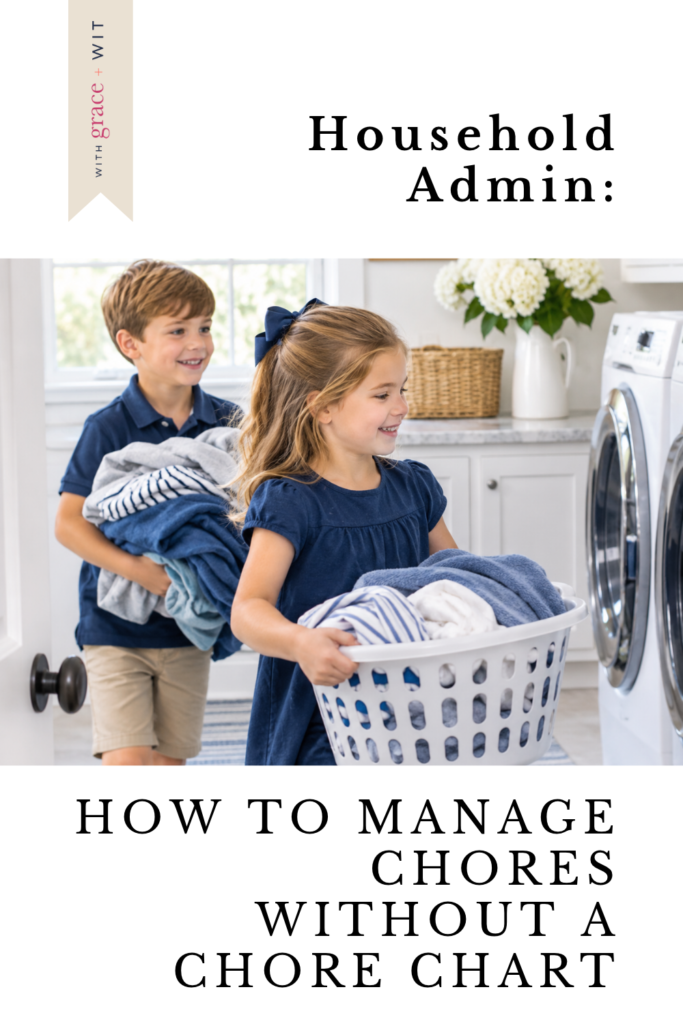
On Thursday mornings, before school, the Alexa in our living room announces that it’s laundry day for the kids. My kids bring their laundry up, and I’m not the one nagging.
Chores need someone to do them, a day, and a way to be remembered. That’s the admin side of running a home, and it’s the part that’s easy to skip. Lists of what to clean are everywhere. It’s harder to find advice on who does each job, when it gets done, and how to manage it so it gets done rather than landing back on my to-do list.
If you’re trying to work out how to divide household chores between kids and adults, this is the household chore system we use at our house. There is no chore chart in it.
What’s Involved in Household Chores
There are many ideas of what a chore is. Why kids should do them, how they should be done, and whether kids get paid for them are all open questions. If you’re the one running your household chore system, those are yours to decide.
For me, household chores come down to four things: the job itself, who does it, when it gets done, and how it gets reminded and managed.
Daily chores are the ones that are back again tomorrow: dishes, tidying, and getting meals on the table. Weekly chores come around once a week, like laundry, floors, and trash. Event chores show up when something out of the ordinary is going on.
Seasonal and annual upkeep is a different category, and I cover it in A Simple Home Maintenance System. This post stays with the day-to-day.
Standing Chores
A standing chore is the same job, on the same day, with the same reminder. Nobody has to decide each week whether it’s happening, because it already is.
If a job comes around on a schedule, it can probably be a standing chore. These tend to work well:
- Laundry
- Emptying trash cans and taking out the trash and recycling
- Changing sheets
- Cleaning bathrooms
- Vacuuming or mopping
- Watering plants
Thursday Laundry
Thursday laundry is our clearest example. I do laundry daily, so Thursday isn’t laundry day for the whole house. It’s the day my kids bring their laundry up. Even when I’m the one washing it, they’re responsible for getting it to the laundry room and putting it away once it’s folded. The job is fixed, the day is fixed, and the reminder is Alexa in the living room, announcing it before school.
It works partly because of who the reminder comes from. When I say it’s laundry day, I’m asking. When Alexa says it, it’s just Thursday. I’m not the bad guy, and I don’t have to remember to say anything.
I turned the reminder off over the summer so it wouldn’t go off before 7 a.m. I’m using it again this school year, because it worked.
Splitting Jobs Based on Ability
Bathrooms are how I think about dividing a job by what each person can do. Until recently, my younger kids cleaned the sink, counters, and mirrors, and I handled the toilets. That let them learn the job in steps, based on what they could do and which cleaning products I was comfortable with them using.
My kids are old enough now to take on pretty much anything around the house, but we’ve only recently gotten there. Splitting a job this way lets it be finished while someone is still learning to clean properly.
Everyone Does the Dishes
After dinner, everyone puts their own dishes in the dishwasher. That part doesn’t change. Anyone who ate at the table is part of the cleaning.
The rest of the kitchen cleanup is divided based on what the evening involves. Between sports practice, homework, other scheduled activities, and sometimes attitude, it goes to whoever has the most time, kids or parents. The jobs are wiping counters, running the dishwasher, sweeping, and taking out the kitchen trash, and I assign them.
This is specific to our house, and other families split dishes differently. When I was growing up, I had one night a week that was mine to do the dishes, and my sister and brother had the other nights. That worked for us too. Either way, someone decided ahead of time.
Event Chores: The Once-Over
Event chores are the extra cleaning that comes before something out of the ordinary. Often that means company, but it can also mean overnight guests, leaving for a trip, or hosting a holiday or a party.
If we’ve kept up with the daily and weekly chores, an event usually needs only a once-over. What that covers depends on the event:
- Hosting a party or a holiday: the rooms the event will be in, usually the living room, dining room, and kitchen.
- Overnight guests: the guest bedroom, with clean sheets.
- Leaving for a trip: a little bit of everything.
- Any of them: the bathrooms.
I divide the list on the day, and everyone helps, because everyone is part of the event.
Why We Don’t Use a Chore Chart
There are two reasons we don’t use a chore chart.
The first is that we’re a blended family, and I’ve tried charts with little success. It gets hard when one child has daily chores on the chart and the others have half as many, or whatever the custody rotation allows. A child’s idea of fairness isn’t always rational or as mature as an adult’s, and a chart puts visibility on a perceived unfairness.
The second is that we’re teaching our kids that sometimes a job simply needs to be done. That’s part of living in a home.
Charts can work for some families, so I’m not going to tell you to throw yours out. A chart may help when:
- You have several kids and the jobs rotate, and nobody can keep track of whose turn it is.
- A child likes checking things off and finds it motivating.
- You’re in a season where a lot is changing and you need to see it written down.
If you do use one, it still needs a job, a person, a day, and a reminder. A chart on the wall that nobody looks at is a list, not a reminder.
Getting Kids to Help Without a Chart
We ask kids to help in four situations:
- Their own spaces: their rooms and their laundry.
- Their own activities: if they get all the toys out in the living room, they take care of putting their things away.
- Family cleaning times: the dinner dishes and getting the house ready for an event.
- Times when we’re busy and need something done. That isn’t a regular occurrence, and kids are usually receptive to it, especially when I explain why and then ask.
A few things make that work without a chart.
A Reminder That Isn’t You
A reminder that comes from somewhere other than a parent keeps the parent out of the nagging role. Our Alexa is the example, and the standing chore days and the after-dinner dishes work the same way: the day or the time says it’s time, not me.
Checking the Job
It’s easy to want to believe I don’t have to check my kids’ jobs, but they’re still learning. Often my husband or I check, and if the job isn’t done well, the kid is asked to finish it.
Occasionally we have the kids check each other’s work. Peer approval can go either way. One sibling makes sure every little speck is cleaned, and another is more relaxed.
Where It Breaks Down
A system like this breaks down when a chore stops happening or stops being done well. Here are the places it tends to start.
The first is a reminder that’s off when you need it. My laundry reminder, for example, was off all summer. If you notice a chore has stopped happening, check the reminder first. It may simply not have gone off.
The second is “out of sight means put away.” In my house, anything that’s been moved out of the way gets counted as done, at least by some of us, and it usually isn’t. A job isn’t finished until it’s where it belongs.
The third is a job that gets called done when it isn’t. That’s why we check.
Try This Week
Start with what you already have.
If you have no system yet, pick one standing chore. Give it a day and a reminder, and tell whoever does it.
If you have a system that isn’t working, go back to the four things: the job, who does it, when it gets done, and how it gets reminded and managed. Find the one that’s missing and fix that.
Either way, plan to check the first few rounds yourself. It won’t hold every week. When it slips, check the reminder first.