Last week was about deciding what deserves your time. This week, we’re asking the same question about your money. Holiday overspending rarely happens with one big purchase. It happens when a long list of individually reasonable decisions adds up to more than you intended to spend.
- “It was only one more gift.”
- “We’ll figure it out later.”
- “Oh, I forgot that was a thing we pay for every year.”
That is especially true at Christmas. You’re making a large number of spending decisions in a short amount of time, across several different categories and several different people. And some of those decisions are emotional. You want your kids to have a good Christmas. You see something that reminds you of someone. You want to make up for a difficult year or create a tradition your family will remember.
None of those things are necessarily bad reasons to spend money. They just make it easier to spend without noticing how quickly the total is growing.
You may purchase birthday gifts every few months. At Christmas, you might be buying gifts for those same people all at once, along with stocking stuffers, food, decorations, cards, wrapping supplies, and everything else that makes the season feel like Christmas.
It’s a little like budgeting for a vacation. You remember the airfare, hotel, and meals. Then you start paying for parking, admission fees, snacks, and everything else that happens around the big expenses. Christmas works the same way.
The answer isn’t to track every possible expense. It’s to look at the whole season before you start spending.

Start With the Amount You Have Available
This may sound obvious, but the first step in creating a holiday budget is knowing how much you actually have available to spend.
- Not how much you wish you could spend.
- Not what you think Christmas should cost.
- And not what you can put on a credit card and deal with later.
Start with the amount that is available for the season.
How you arrive at that number will look different from household to household. Maybe you’ve been saving throughout the year. Maybe you set money aside beginning in the fall. Maybe part of your regular income or an annual bonus is designated for Christmas.
And if you haven’t saved for Christmas this year, that doesn’t mean you’re out of options. It means you need to start with the money you actually have and decide what you can reasonably add to it.
Maybe that means picking up some extra work. Maybe it means selling something you no longer need. Maybe it means using money that becomes available later in the year. Maybe it means making this Christmas simpler than you originally imagined.
We’ve had tight years too. There were years when we sold things to help cover Christmas. Looking back, I don’t regret it. Seeing the joy on our kids’ faces mattered more to me than holding on to something we were willing to let go of.
The point isn’t that you need to find extra money at all costs. It’s that you can make a plan with the financial reality you actually have.
The Source Matters Less Than the Order of Operations
Know the amount first. Then decide how to spend it.
That one decision changes the rest of the budget. You’re no longer adding purchases until Christmas feels complete and hoping the total works out. You’re working with a number that already has a limit.
If you don’t know exactly where the rest of your Christmas money will come from yet, make a conservative estimate and keep that number visible. As additional money becomes available, you can add it to the budget.
What you don’t want to do is spend against money that might be there.
Decide What Your Holiday Budget Covers
Once you know the total, figure out what needs to come out of it.
This is where holiday budgets can get messy. We tend to think about the big expenses first: gifts, Christmas dinner, maybe the tree. But the season includes a lot more than those things.
For our household, the Christmas budget needs to account for things like:
- Gifts for immediate and extended family
- Stocking stuffers
- The Christmas tree
- Decorations
- Christmas Eve and Christmas dinner
- Christmas cards and postage
Other holiday expenses stay within our regular monthly spending instead. I try to account for things like baking, teacher gifts, and gas for getting to holiday parties as they come up. I also increase our grocery budget a little for the Thanksgiving and Christmas season.
There isn’t one correct way to divide these expenses.
If you already have a monthly budget for experiences, for example, a holiday concert may already have a place there. You don’t need to create a new Christmas category simply because someone else’s budget has one.
The important thing is to know which expenses your holiday total is responsible for and which ones are already accounted for somewhere else.
And don’t dismiss an expense because it seems too small to matter. Wrapping paper, postage, shipping, gift bags, and tape may not deserve their own category. But if they add up to $75, $100, or more over the season, they matter to the total just the same.
Small expenses aren’t necessarily a problem. A lot of small expenses happening at the same time can be. Before the season gets busy, take ten minutes and make a list of the expenses you expect to have. Then mark each one as either Christmas budget or regular household budget. You don’t need a perfect number yet. You just need to know which bucket each expense belongs in.
Let Your Household Decide How the Money Gets Spent
Now that you know how much you have and what it needs to cover, you can decide where that money should go. This is where your holiday budget becomes personal. For our family, the amount we plan to spend is influenced by a few things.
What did we spend last year?
Last year’s Christmas gives us a useful starting point. It helps us remember expenses we might otherwise overlook and gives us a realistic picture of what our Christmas actually costs.
How many people are we buying for?
We think about immediate family and extended family separately because they aren’t necessarily handled the same way. Friends may have their own place in the budget too, depending on your family and traditions.
How old are our kids?
This one matters more than a simple “$X per child” formula would suggest. We’ve bought Christmas gifts for a six-year-old and a sixteen-year-old in the same year, and the same amount of money doesn’t necessarily buy the same kind of Christmas for both. You can buy a lot of Barbies for $100. That same $100 doesn’t go nearly as far when your older child wants the latest Apple AirPods.
You can choose to budget for your kids however you want. But their ages, interests, and the things they actually need or want are worth considering before you decide on a number.
And then there is the most important question:
What matters to us?
For our family, a traditional Christmas morning matters. We have children ten years apart, so what makes sense for the oldest doesn’t always make sense for the youngest. But Santa still comes to our house, and that’s a tradition we’re willing to spend money to maintain.
We also still buy a real Christmas tree and drive 45 minutes to the same tree farm we found the year we got married. There are closer options. We’ve tried them. We prefer this one, so we make the drive.
Those decisions are part of the budget too.
A budget isn’t supposed to tell you what you’re allowed to value. It gives you a way to make room for what you value. And knowing what matters also makes it easier to simplify the things that don’t.
Teacher gifts are a good example for us. I used to make everything by hand—first food gifts, then homemade crafts once I realized I didn’t know everyone’s allergies. Now our kids’ school provides a list of each teacher’s favorite candy, coffee order, and other preferences.
Now, I use the list.
It’s not less thoughtful. It’s better information doing the work that homemade effort used to do.
Your answers to these questions will be different from mine. That’s exactly why there isn’t a universal holiday budget that will work for every family.
The questions are what matter:
What can we spend? What needs to come out of that amount? And what matters enough to us that we’re willing to spend it?
Spend the Total Down, Not Up
This is the part that makes the budget useful.
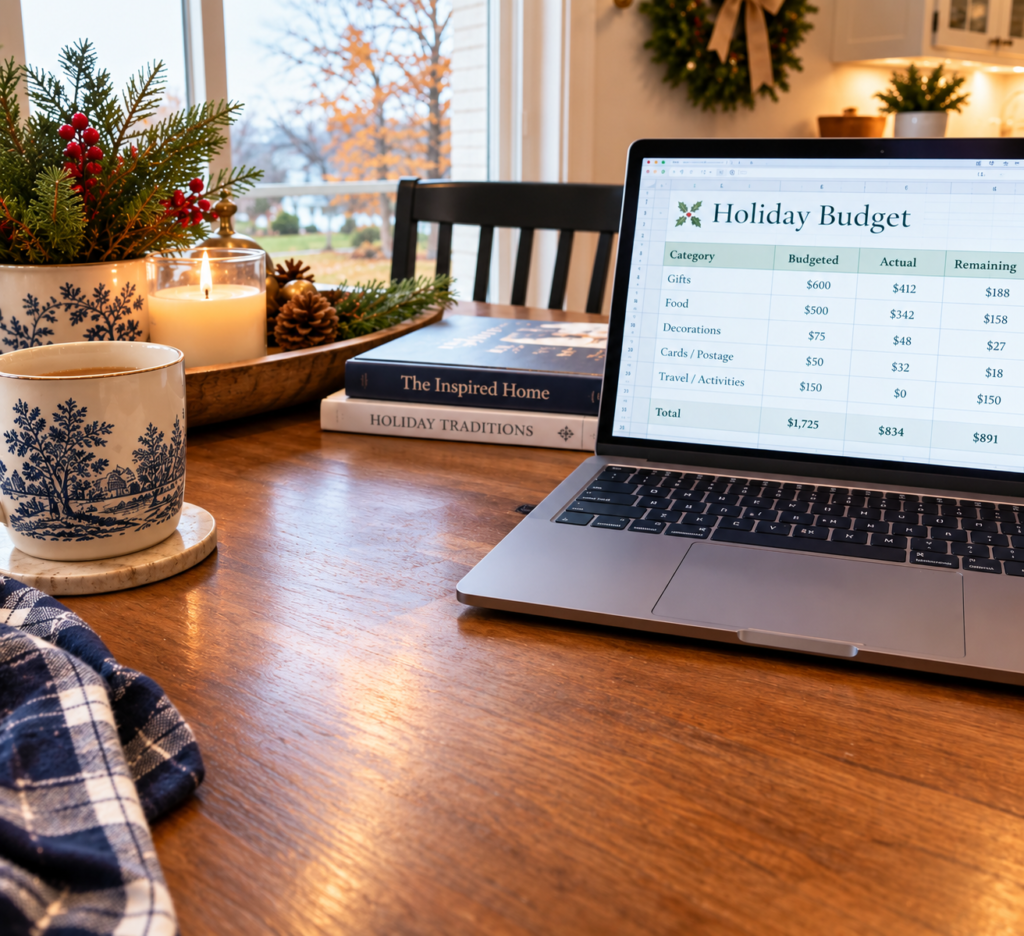
Once we know our total, I create a spreadsheet with the overall amount and a rough guide for how much we expect to spend on each person. It isn’t meant to predict every purchase perfectly. It’s a way to keep the total visible.
Christmas is not one big trip to the store. It’s a series of purchases spread across weeks and sometimes months, which makes it surprisingly easy to lose track.
Take a Black Friday or Amazon sale, for example. You see the perfect gift for $24.99 and put it on your spreadsheet.
Except the actual charge isn’t $24.99. There’s sales tax.
A dollar or two probably won’t change your Christmas. But if you spend $500 throughout the season and consistently forget to account for tax, that difference adds up. Depending on your state and local tax rate, you could be looking at another $30 or more.
That $30 could be another gift.
The same thing happens when you’re buying groceries and see the perfect gift on sale. You weren’t making a Christmas purchase when you walked into the store, but you are now. Put it on the spreadsheet.
The goal isn’t to make every purchase feel like an accounting exercise. It’s simply to remember that every Christmas purchase counts, even when it happens somewhere other than the Christmas shopping trip.
As we spend, the total comes down.
There are always a few expenses I didn’t anticipate. That’s part of the season, so I leave room for extras.
And sometimes the perfect gift appears after I’ve already bought something else. If that happens, I’ll return the first gift and buy the better one. I’m not above exchanging gifts to create a better gift-giving experience, but I try not to.
The goal isn’t to follow the spreadsheet perfectly. The goal is to use the money we’ve decided to spend in the way that makes the most sense. The spreadsheet simply keeps me from losing sight of the total while I’m making all those individual decisions.
You could do the same thing with a budgeting app, a notes page, or a piece of paper. The tool doesn’t matter much.
What matters is that you can see how much you started with, how much you’ve committed, and how much is left.
Don’t Forget Halloween and Thanksgiving

Christmas gets most of the attention when we talk about holiday budgets, but Halloween and Thanksgiving belong in the picture too. For us, those expenses are handled differently because they fit more naturally into our regular monthly spending.
Halloween might mean costumes and candy. Thanksgiving might mean a larger grocery bill or the cost of traveling to family. They are still holiday expenses, but they don’t have to be part of the same Christmas spending total.
That’s an important distinction.
A holiday budget doesn’t have to mean one giant holiday account covering every expense from October through December.
It means you know how your household is paying for the season and where those expenses are being accounted for. Christmas is simply the holiday where I find it most useful to step back and look at the whole picture before we start spending.
Give Yourself a Plan Before Christmas Gets Busy
A holiday budget isn’t complicated. It’s really three decisions:
- Know how much you have available.
- Decide what that amount needs to cover.
- Keep the total visible as you spend.
Then use your family’s priorities to decide where the money should go.
You don’t need to predict every purchase perfectly. You don’t need a complicated budgeting system. And you don’t need to turn Christmas into a spreadsheet exercise.
You just need to know what you have to work with before the spending starts.
Because the point of a holiday budget isn’t to make Christmas smaller.
It’s to take the stress out of spending—and make sure the Christmas you planned for is the Christmas you actually pay for.