There is something my husband and I joke about from time to time: why does work sometimes seem easier than home?
It isn’t because we don’t love being home—we do. And it isn’t because the problems at work are actually easier; some of them are exasperating in their own way.
But work has a distinct endpoint. Raising children doesn’t.
Just when you think you’ve mastered one season, your child grows, the circumstances change, and suddenly you’re navigating the next. It is, in many ways, frustratingly rewarding.
One of the biggest skills we teach without always realizing it is how to contribute to a household.
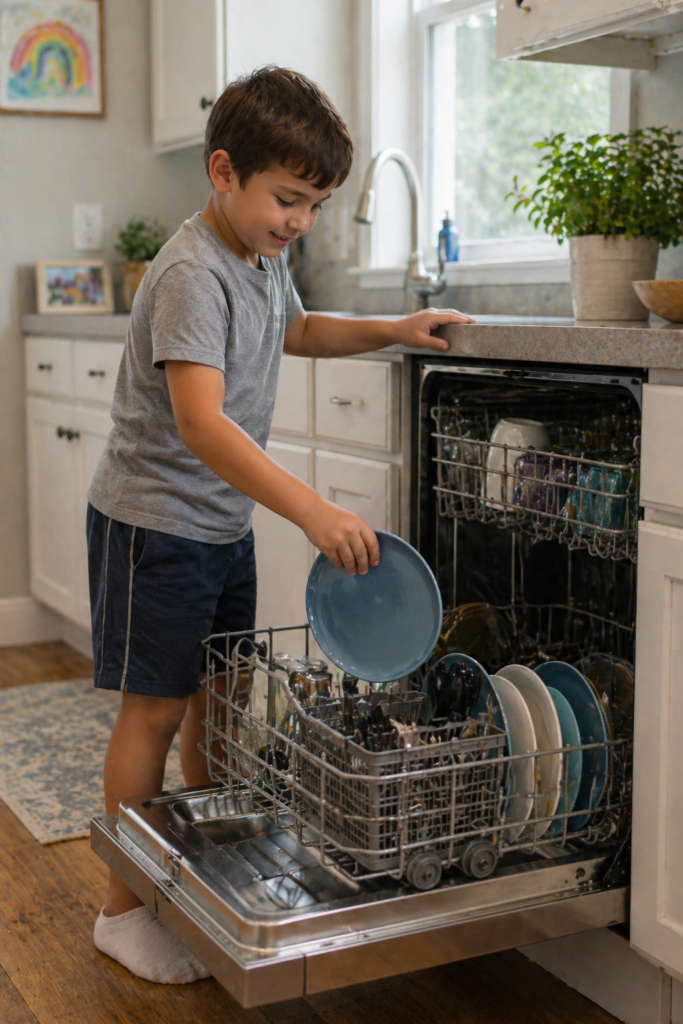
We teach our kids how to clean their rooms, put away laundry, feed the dog, clear dishes, and help with dinner. But underneath all of those individual tasks lies a much bigger, foundational skill:
Can they notice what needs to be done?
Eventually, the goal isn’t just to raise a child who can complete a chore when an adult assigns it. The goal is to raise a human who can look around a room, recognize what needs to happen, take ownership of their part, and act—without waiting for someone else to manage them.
That is a very different kind of responsibility.
Helping Begins with Awareness
I was fascinated by the concept of children becoming “observantly helpful” in the book Hunt, Gather, Parent by Michaela Doucleff.
The idea isn’t simply that we need to hand kids a longer list of chores. It’s that children can learn to notice what is happening around them and naturally participate in it.
Think about the difference:
- Scenario A: You’re carrying armloads of groceries into the house. Your child sees you struggling at the door and says, “I’ll get those.”
- Scenario B: You stand in the kitchen and call out, “Can you come carry these groceries in?”
In Scenario A, the child noticed an opportunity to contribute.
That kind of helpfulness isn’t just a personality trait a child is born with—it’s a habit of mind. It can be practiced until it becomes part of how your family operates.
Often, it starts with tiny, quiet moments of awareness:
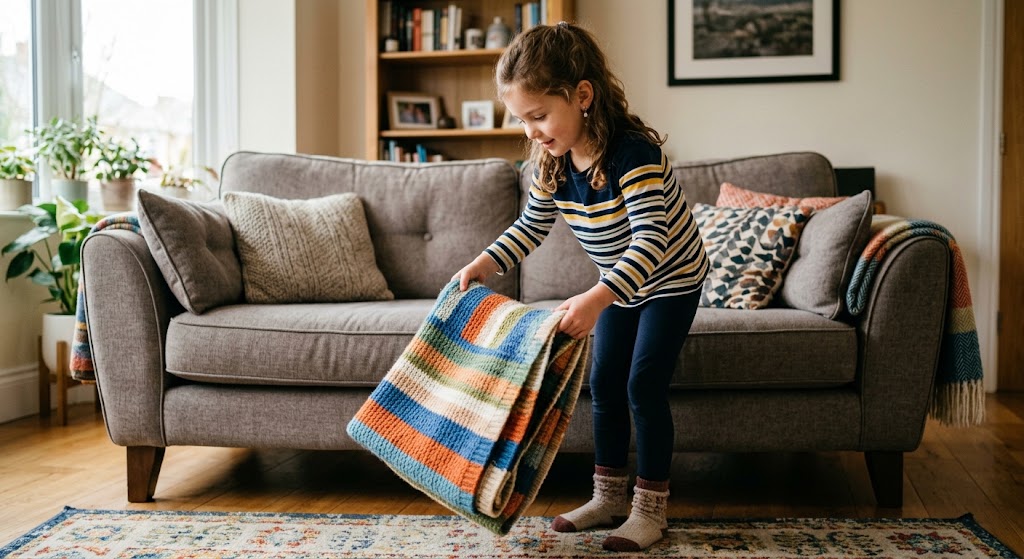
- A child is snuggled under a blanket on the couch. When bedtime comes, they fold the blanket before leaving instead of dropping it on the floor for someone else to step over tomorrow.
- They’re racing outside to play the second the doorbell rings, but take ten seconds to throw away their granola bar wrapper first.
- They’re heading downstairs empty-handed, notice a sibling’s toy sitting on the steps, and pick it up on their way down.
- Or one of my favorites: they’re already in the kitchen getting water and call out, “Does anyone else want anything while I’m up?”
None of these are formal chores. They are moments of situational awareness—and over time, those moments stack up.
Responsibility Starts with Ownership
Children usually understand the concept of personal ownership long before they understand household contribution.
A toy received for a birthday? They know it’s theirs. A bike bought with saved allowance? They remember where they parked it. The shoes they picked out themselves? They suddenly have very clear opinions on how those shoes are treated.
That makes personal ownership the most natural place to start: You take care of what belongs to you because it is yours.
Gradually, as kids mature, that circle expands: You take care of shared spaces because you belong to a family.
They learn not to leave a blanket in the middle of the floor because someone else uses the living room too. They stop walking past a mess empty-handed because they realize their contribution makes life smoother for everyone.
It shifts their mindset from “How do I avoid getting in trouble?” to “My actions directly affect the people I live with.”
Stop Managing Every Step (Shift from “Manager” to “Guide”)
This is usually where we get stuck as parents. We want our children to be responsible, but we also just need the day to function. And in the heat of the moment, managing the process ourselves feels so much faster.
“Did you brush your teeth?”
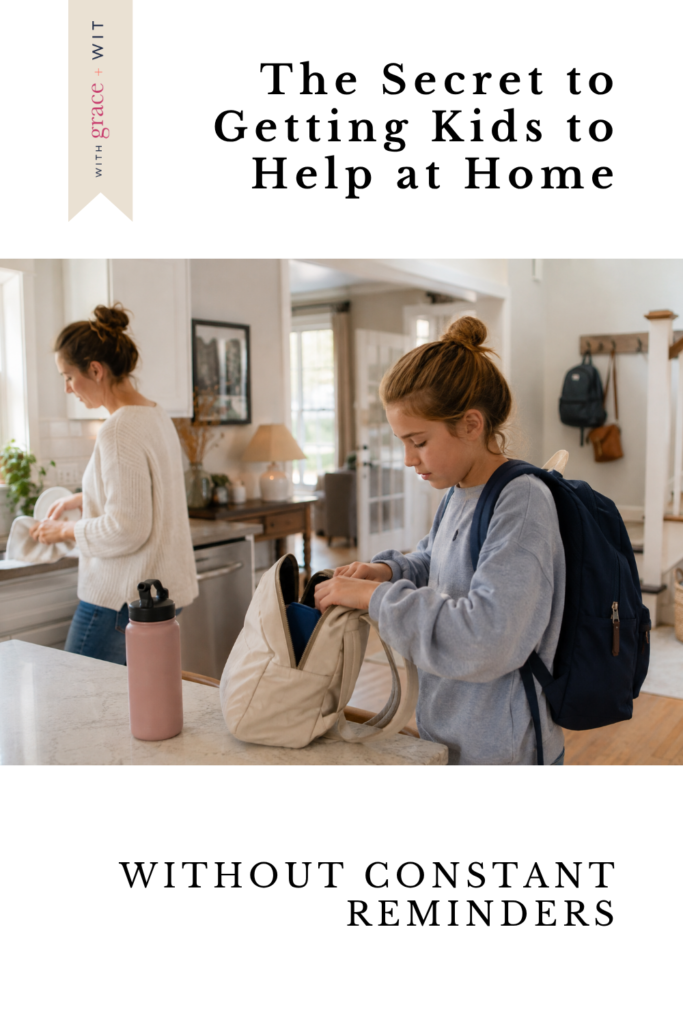
“Did you pack your backpack?”
“Did you feed the dog?”
“Did you put your shoes by the door?”
It’s exhausting.
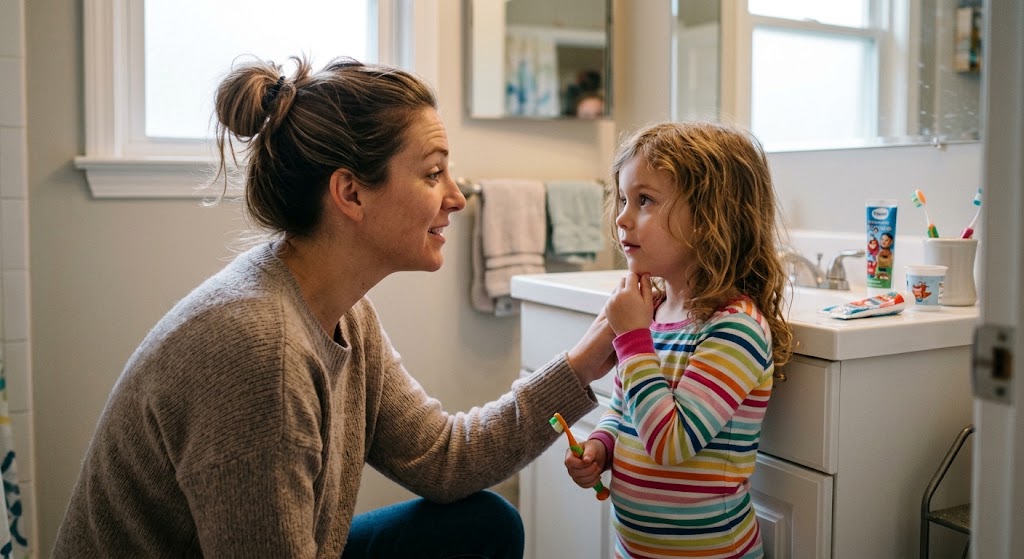
We aren’t trying to micromanage; we’re trying to keep the morning moving while packing lunches and answering an email. When we don’t have twenty minutes to stand beside a child and walk them through a multi-step sequence for the fourth time this week, we do the executive functioning for them because it saves time.
The problem? If we are always doing the remembering, sequencing, and prompting, our kids never get to build those mental muscles.
Try shifting the central question you ask in your house.
Instead of walking through a checklist (“Did you pack your bag? Did you get your water bottle?”), ask a single, open question:
“What’s next?”
“Did you finish everything?” keeps you in the role of the store manager checking inventory.
“What’s next?” hands the clipboard over to your child.
At first, they might look at you blankly. That’s normal. You can prompt gently: “Think about what we need before we step out the door.”
Eventually, they begin running through the mental list themselves: “I need my shoes, my backpack, and my lunch.”
What About Timing and “Negotiation”?
As kids start taking over their own mental checklists, you’ll naturally run into timing discussions. It’s easy to view a child’s response to a chore as defiance, but there is a big difference between outright refusal and an attempt to manage their time:
- Refusal: “I’m not doing that.” or “Make my sister do it.”
- Awareness Response: “My friends are coming over later—can I clean up after they leave so I only have to do it once?” or “Can I finish this chapter first?”
When a child offers an alternative timing plan, they aren’t necessarily bargaining their way out of work—they’re processing the task, acknowledging ownership, and trying to navigate their schedule.
For us, the rule is simple: The responsibility itself isn’t negotiable, but the timing sometimes can be. Validating their ability to plan ahead teaches them how to manage real life, where tasks rarely exist in a vacuum.
Re-Thinking Motivation Beyond Chore Charts
We often worry that if kids aren’t driven by an immediate reward, they won’t do anything. But adults rarely operate on a single type of motivation either. We work for a paycheck, sure, but we also take pride in a job well done, enjoy feeling competent, and like contributing to a team.
A child might start out motivated by a sticker chart or an allowance. That’s fine. But as they grow, we want to help them unlock deeper internal motivations:
- “I can do this myself.”
→ - “I know how to handle this.”
→Mastery - “I noticed what needed to be done.”
→Awareness - “I made someone’s day a little easier.”
→Connection - “I’m proud of how I handled that.”
→Self-Efficacy
Learning to recognize internal satisfaction—and finding motivation beyond an instant reward—is a skill that will serve them long after they leave your home.
Why Tools Aren’t Systems
This is why reliance on chore charts often breaks down over time.
Chore charts can be helpful during consistent seasons, like summer routines. But during the school year—especially in busy households balancing shifting extracurriculars and changing schedules—charts can quickly turn into another administrative task on Mom’s plate.
If you have to create the chart, update the chart, remind everyone to look at the chart, and monitor whether it was checked off… you are still managing the entire system.
A chore chart is just a visual tool. It is not a substitute for teaching a child how to look around, read the room, and take initiative.
Change the System to Fit the Stage
Shifting responsibility to your child doesn’t mean handing them a complex job and expecting them to execute it flawlessly without support. Sometimes, when a child consistently fails at a task, it’s not an attitude problem—it’s a system problem.
Take laundry, for example.
When my kids were younger, handing them one giant basket of mixed clothes usually meant those clothes ended up shoved in a pile in the closet. The task was visually and organizationally overwhelming for their age.
So, I adapted the system: I presorted their clean clothes into clear sub-piles (shirts together, pants together, socks together). They were responsible for carrying each small stack to its designated drawer.
I wasn’t doing the work for them; I was scaffolding the process so they could succeed. As they grew, the structure shifted, and they took over more steps.
Scaffolding allows your child to practice a skill without you having to step in and reclaim full ownership of the job.
Start Small: Notice the “Noticing”
If you want your kids to contribute more without constant nagging, you don’t need a more complicated chart. You just need to start pointing out opportunities for awareness.
Ask simple, low-stakes questions as you go about your day:
- “Do you see anything that needs to happen before we leave the house?”
- “You’re already heading upstairs—is there anything sitting on the steps that belongs up there?”
- “You’re grabbing a snack—does anyone else need anything while you’re in the kitchen?”
And when you catch them taking initiative on their own, validate the awareness, not just the finished task:
- “I noticed you saw that blanket on the floor and put it away.”
- “You remembered your water bottle without a single reminder today.”
- “That was really thoughtful of you to bring your sister’s shoes down.”
You’re drawing their attention to the habit of mind itself.
The ultimate goal was never to raise kids who perform tasks like clockwork or keep a pristine house. The goal is to raise thoughtful, capable humans who know that being part of a family—and a community—means noticing the world around them and stepping up to contribute.
And in the long run, that is a much bigger win than just getting the dishes done.
A Place to Start This Week
Don’t worry about throwing away your current routine or trying to overhaul your entire household strategy tonight. Start small with one simple swap.
Tomorrow morning, when you’re tempted to rattle off the usual five-item checklist (“Did you brush your teeth? Grab your bag? Get your shoes?”), pause. Take a breath, step out of the manager role, and ask just one question instead:
“What’s next?”
See what happens when you give them the space to fill in the blank. You might be surprised by how much they already know—or at least discover exactly where you can start helping them see it.