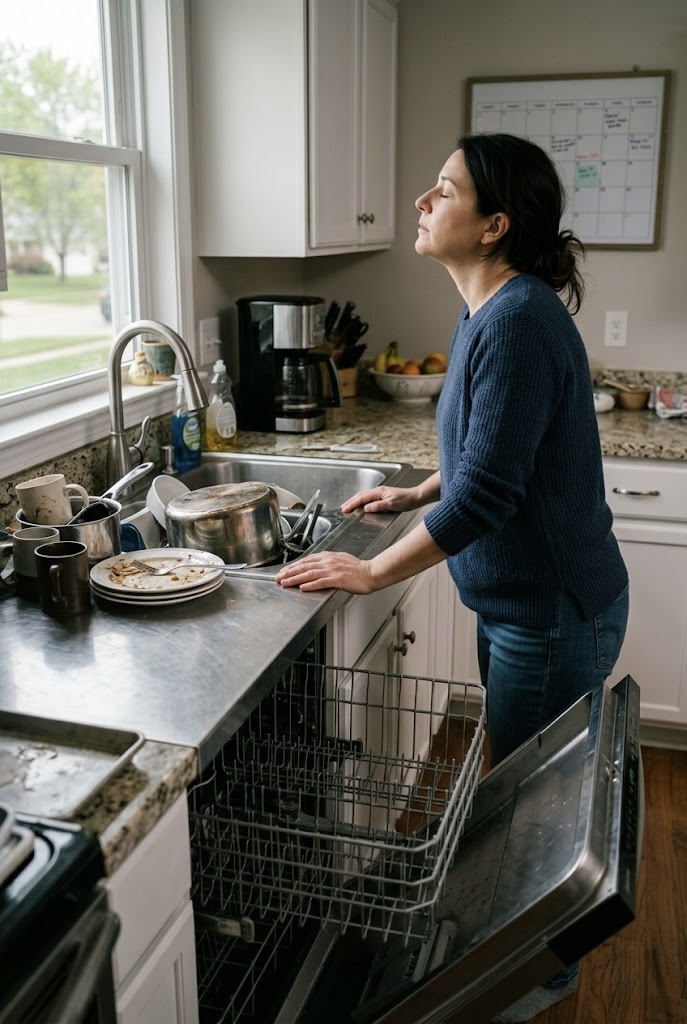
If you are currently sitting at your kitchen sink, staring at a half-eaten bowl of cereal left by a teenager who just woke up at 10:30 AM, while a younger child asks you for the fourteenth snack of the morning—take a deep breath. This is a very normal part of summer parenting.
There is a specific reason why summer feels like a logistical nightmare, and it isn’t just because the kids are home.
We often hear that summer is supposed to be a “break.” We imagine slow mornings and intentional afternoons. But for most of us, the transition from May to June isn’t a shift from “busy” to “calm.” It’s a shift from predictable chaos to unpredictable chaos. And that unpredictability is exactly what is wearing you out.
And honestly, part of the challenge is that modern summers look different than they used to.
A lot of us grew up disappearing outside for hours at a time. Now our kids are home more, on screens more, and cycling through snacks like it’s a competitive sport.
Which means the house never really empties out or settles down.
What Changes When School Ends
Before we solve the chaos, we have to name it correctly. There is a common trope that the school year is “the busy time” and summer is “the slow time.” But let’s be honest: May is a gauntlet. Between school concerts, spring sports (and the inevitable rain-out make-up games), Mother’s Day, and Memorial Day, the calendar is packed.
However, May has a secret weapon: a Routine.
In May, even if you are running to a 6:00 PM baseball game, you know exactly what time everyone had breakfast. You know when lunch happened. You know that by 8:00 AM, the “work” of the day has begun. The school year provides a built-in rhythm that holds your household upright.
When June hits, that rhythm disappears. Suddenly, you aren’t just the parent; you are the Short-Order Cook, the Entertainment Director, the Referee, and the Housekeeper—all while trying to maintain your own rhythms and sanity.
The Real Root of Summer Overwhelm
The “logistical nightmare” of summer usually boils down to three specific pressure points:
1. The Disappearing Reset
When kids are at school, the house has a chance to breathe. In summer, the house is under constant pressure. Activities, sports gear, and “projects” (a.k.a. piles of cardboard and glue) migrate from room to room. Because there is no “end of the school day” or “home from work” transition, the house never feels truly reset.
For those of us who operate best in a routine, this “visual noise” is exhausting. It feels like you are constantly cleaning up the same five square feet of space while the rest of the house slowly unravels.
2. The Decision Fatigue of “I’m Bored”
This is the phrase that strikes fear into the heart of every mother. When our kids tell us they are bored, our instinct is to be helpful. We want to be the “fun mom,” so we start brainstorming. “Do you want to go to the park? Want to paint? How about a bike ride?”
But here is the truth: By offering choices, you are taking on the mental load that belongs to them. You are preventing them from learning how to direct themselves.
3. The Blood Sugar Rollercoaster
Without the strict lunch bells of school, summer eating becomes a free-for-all. Breakfast happens at 10:00 AM, lunch is skipped for snacks, and by 3:00 PM, everyone (including you) is facing a massive blood sugar crash. This leads to “hangry” outbursts, low energy, and a general sense of irritability that poisons the afternoon.
What to Fix First: The Strategy of Expectations
Instead of trying to “fix” summer with a rigid 7:00 AM – 9:00 PM schedule (which will likely last three days before it’s abandoned), we need to focus on expectations.
Fix #1: Establish the “Food Windows”
If you’ve tried a full-scale meal plan with pre-prepped snacks and found it too time-consuming, you aren’t alone. It’s a lot of work for a moving target—especially when friends start dropping by.
Instead, try a Window Approach. Establish clear times when the kitchen is “open” and “closed.”
- The Brunch Window: If you have middle-schoolers sleeping late, breakfast/lunch happens between 10:00 and 11:30.
- The Snack Bin: Set out a designated bin for the day. Once those snacks are gone, the kitchen is closed until dinner.This protects you from being a short-order cook all day and helps the kids learn to regulate their own bodies.
Fix #2: Use a “Summer Skills” To-Do List
Structure is a form of kindness. By giving your kids a clear list of what is required of them each day, you are removing the “What do I do now?” friction.
A simple daily list should include:
- A Contribution: A chore or a way they help the house “reset.”
- A Brain Task: Reading or math to prevent the “summer slide.”
- Physical Movement: Getting outside or being active.
Screen time only happens once the list is done. This creates a rhythm where they earn their leisure, which makes that leisure much more satisfying. (For a deep dive into how I set this up and how I get my older kids to buy in, check out my post on fostering independence here).
Fix #3: Master the “Boredom Script”
When the “I’m bored” chorus starts, you need a script. You don’t have to be the “bad guy,” but you do have to be a firm boundary-setter.
Try this: “It sounds like you have a lot of free time on your hands! I trust you to find something creative to do. If you can’t find something in the next five minutes, I have a few deep-cleaning chores I’ve been looking for help with.”
Ninety-nine percent of the time, they will magically find an activity. By doing this, you aren’t being mean; you are telling them, “I believe in your ability to entertain yourself.”
The Goal: A Calm Bedtime
We don’t create these systems because we want to run our homes like a boot camp. We create them because we want to enjoy our kids.
When you set clear expectations around food, chores, and boredom, you stop being the “manager” of everyone’s minute-to-minute happiness. You can go back to being the mom.
If your kids are already home for the summer, start with one small fix this week — maybe it’s the food window or maybe it’s the to-do list.
And if summer hasn’t officially started yet, this is the perfect time to decide what rhythms and expectations you want in place before the chaos fully arrives.
Because the goal isn’t a perfectly clean house or a Pinterest-worthy summer. The goal is a home that feels calmer, lighter, and more enjoyable for everyone living in it.