I’m a DIY girl. Have been for most of my adult life — not because I had some romantic vision of handcrafting everything, but mostly because I had more patience than money. When you can’t buy something, you figure out how to make it. That’s just math.
I went to art school. I ran an art business. I have refinished more pieces of furniture than I care to count, made my own party invitations, designed my own labels, and planned meals from scratch because the alternative cost more. For a long time, DIY wasn’t a lifestyle choice — it was just what I did.
But here’s what I’ve learned after years of doing it all myself, and then having kids, and then watching my available hours shrink in ways I genuinely did not anticipate: cheaper doesn’t always mean wiser. And doing it yourself isn’t always the better choice — even when you can.
The hidden cost of “doing it all yourself”
There’s a version of DIY that feels empowering, and there’s a version that quietly drains you. They can look identical from the outside.
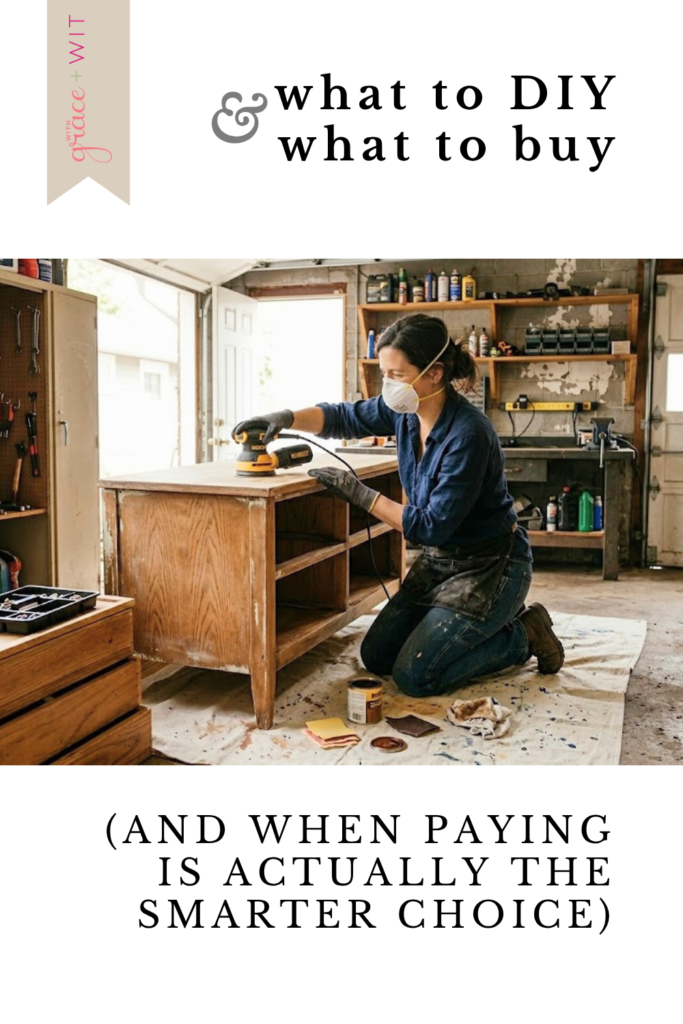
I once refinished a piece of furniture that I was genuinely proud of. It turned out beautifully. But by the time I was done — the prep, the sanding, the coats, the waiting, the second-guessing — I was so over it that I sold it. Not because I needed the money. Because I needed it out of my house.
That’s not a success story. That’s a cautionary tale dressed up as one.
The real cost of DIY isn’t just the supplies. It’s the mental space the project occupies while it sits unfinished. It’s the half-done thing in the corner of a room that you walk past for three weeks feeling vaguely guilty. It’s the “one more tube of something” that requires another trip to the store. DIY projects have a way of expanding past their original scope — and usually right after you’re already committed.
I recently bought a dresser at a digital auction. Solid wood, great price, and I was confident I knew what I was getting. Then I picked it up in person and realized it needed a little work. I wasn’t going to do a full refinish — I don’t have time for that right now — but while cleaning it I got a serious sliver, which told me it needed at least some sanding. Which meant some refinishing. The scope grew the moment I touched it.
This is normal. This is DIY. The question is whether you accounted for that before you started.
Note: This post is focused on the everyday stuff — crafts, furniture, creative projects, organizational systems. If you’re staring down a bathroom remodel or a new back deck, the same thinking applies, but there’s a whole additional layer to work through: permits, equipment rental, contractor bids, and timeline risk. That deserves its own conversation — and its own post.
A simple filter for better decisions
I don’t use a formal framework when I’m deciding whether to DIY something or just buy it. But when I look back at the decisions that went well, a few things were always true.
I actually wanted to do it. Not “I feel like I should do this myself.” Not “I could do this.” I mean I genuinely wanted to. There’s a big difference between a project that sounds like a good idea and one you’ll still be glad you started three weeks in.
I had real time — not optimistic time. Not “I can probably squeeze this in on Saturday.” Real, honest, this-is-actually-available time. If you have to talk yourself into believing you have bandwidth, you probably don’t.
The quality justified the effort. That dresser was solid wood. That mattered to me. You can’t buy that construction new at that price point. The refinishing was worth it because the underlying piece was worth it. If it had been particle board, I would have kept scrolling.
Buying it wouldn’t produce something better. Sometimes you DIY because you genuinely get a better result. Sometimes you’re just delaying because spending money feels indulgent. Those are two very different situations.
When I started thinking about it this way, I stopped asking “can I do this myself?” — which is almost always yes — and started asking “should I?”
Use the decision tree
When you’re on the fence about a project, run it through this before you commit.
Where paying actually creates space in your life
Here’s where I want to be honest with you, because I’ve been the person who thought buying anything pre-made was a cop-out.
I’m an artist. I know how to design a birthday party invitation from scratch. I know how to make it look exactly the way I want. But the party is in two weeks, the kids need to be picked up, dinner isn’t made, and my free time doesn’t always line up with my to-do list. Sometimes the best version of that invitation is the one that actually gets sent.
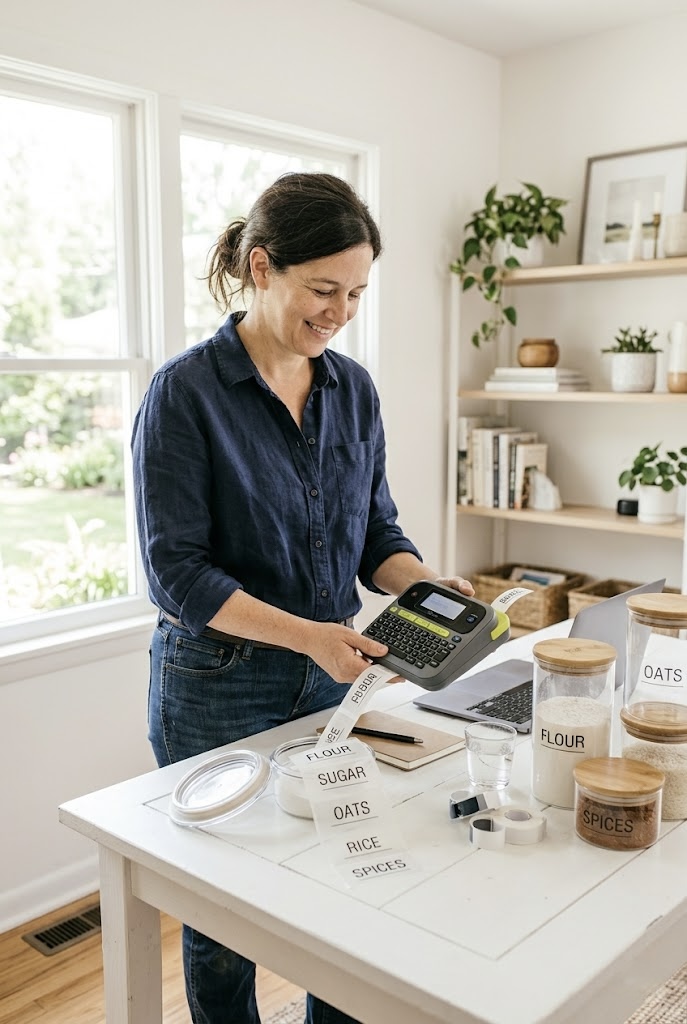
Same goes for pantry labels. I could make them. I have made them. They were great. Now I buy them, and they’re also great, and I spent that hour doing something that wasn’t eating at me.
And here’s one people don’t always think of: food. DIY doesn’t only mean a paintbrush and a sander. It also means the Sunday you spent batch cooking instead of picking up a Stouffer’s lasagna. Sometimes that trade is absolutely worth it — bulk cooking saves real money and you know exactly what’s in the food. Other times, the math and the mental load tip the other direction, and the lasagna wins. Neither answer is wrong. It depends on your week. (Food decisions are their own rabbit hole — bulk buying, meal prep, baking from scratch vs. a bakery cake)
The places where paying tends to make the most sense for everyday projects and tasks:
- When it’s recurring. A one-time project is different from something that happens every week. If you’re rebuilding the same organizational system from scratch every few months because the handmade version keeps falling apart, that’s a sign. Repetition has a way of turning “creative” into “draining” if you’re not careful.
- When your time is genuinely spoken for. Not “I’m busy” in a vague way. Actually spoken for — kids, work, commitments that don’t move.
- When the result is good enough. You don’t always need the custom DIY version. Sometimes a purchased option that’s ready to go — even if it’s not perfectly tailored — does the job just as well in real life. “Good enough and done” often beats “perfect but unfinished.”
- When the DIY version costs more than you think. Add up your supplies, your time, any redos. Run the actual math before you decide the purchased version is the expensive option.
Spending without guilt (when it lines up with what matters)
This is the part I had to learn the hard way: buying something isn’t a character flaw.
For a long time, I DIY’d everything because I had to. That built a habit — and habits have a way of outlasting the circumstances that created them. Even after my situation shifted, I kept defaulting to “do it myself” because it felt more responsible. More resourceful. More like the person I thought I was.
But there’s a difference between being resourceful and being unwilling to let yourself have help.
When the money you spend creates genuine breathing room — less stress, more time with your kids, fewer tasks sitting on the back burner of your brain — that’s not indulgence. That’s intentional. It’s using a resource you have (money) to protect a resource that doesn’t refill (time, energy, mental space).
I’m not saying spend carelessly. I’m saying: when the purchase is aligned with what actually matters to you, you don’t have to feel guilty about it. The goal was never to do everything yourself. The goal is a life that works.
And sometimes a pre-made pantry label, a bought birthday invitation, or a piece of furniture you don’t refinish into the ground is exactly what a life that works looks like.
The next time you’re staring down a project — or a purchase that feels a little too easy to say yes to — ask yourself one honest question: is this choice creating more room in my life, or less? That answer is usually clearer than we let ourselves admit.