Can I tell you something a little embarrassing?
I really used to believe that if I just found the right bins—the clear ones, the stackable ones, the ones with the cute calligraphy labels—everything would finally calm down. I thought the problem was just that I hadn’t reached “Peak Organized” yet.
So, I reorganized the spice drawer. Then the toy closet. Then the bathroom cabinet. And somehow… I was still exhausted.
Here’s what I finally realized: I wasn’t overwhelmed because I was disorganized. I was overwhelmed because I was organizing the wrong things.
I was spending all my “me time” micro-managing areas that didn’t need precision. What my home actually needed wasn’t tighter control—it needed realistic home organization. Once I stopped trying to make every corner Instagram-perfect and started organizing for the actual humans who live here, the whole house started running better.
The 30-second Read
Family life doesn’t need perfect systems — it needs sustainable ones. If you’re reading this while hiding in the pantry for a five-minute break, here’s the heart of it:
- Organize for the version of you that exists right now — not the fantasy one.
- Choose big, forgiving categories over tiny, fragile ones.
- If it’s hard to reset, it’s the wrong system — no matter how beautiful it looks.
- “Miscellaneous” is a legitimate category in a real home.
- Put your energy only where it lowers daily stress.
Simple systems. Real life. Less pressure.
Now, let me tell you what I officially took off my to-do list.
1. Aspirational Clutter
I don’t organize hobbies I’m not actively doing. That sourdough phase. The scrapbooking supplies. The workout program that lasted three days.
Here’s what I learned: organizing something is a form of commitment. When we build a whole system around an unused hobby, we’re quietly telling ourselves, “I should be doing this.”
Instead of perfectly organizing supplies for a life I’m not living right now, I gather those items together and simply ask:
- Is this still part of my real life?
- Do I have time and desire for this in this season?
- If not, do I need to store it… or release it?
Sometimes the answer is “store it intentionally.” Sometimes it’s “it’s time to let this go.” Either way, I stop giving prime household real estate and mental energy to something that isn’t active.
And that frees up time, space, and honestly — grace.
2. Tiny, High-Maintenance Kid Systems
I’ve stopped organizing my kids’ spaces in ways they can’t actually maintain. It’s not that I’ve given up on order or responsibility—I value those things deeply—I’m just tired of the daily friction.
I used to model our home after what I saw in classrooms. You know the drill: markers in one bin, crayons in another, glue sticks over there. At school, it’s remarkable; every kid knows exactly where things go, and they can pack up the whole room in ten minutes. I kept wondering why my home couldn’t operate like that.
I eventually realized that the rhythms of a school don’t translate to a home. At school, blocks are a math tool used for twenty minutes at a desk. At home, those same blocks become coins, cell phones, or doll furniture. They end up in five different rooms, not just on one table. At school, the complexity is in the organization system. At home, the complexity is in the play itself.
When systems are too delicate or time-consuming, kids don’t “rise to the occasion.” They just give up. And then we fight.
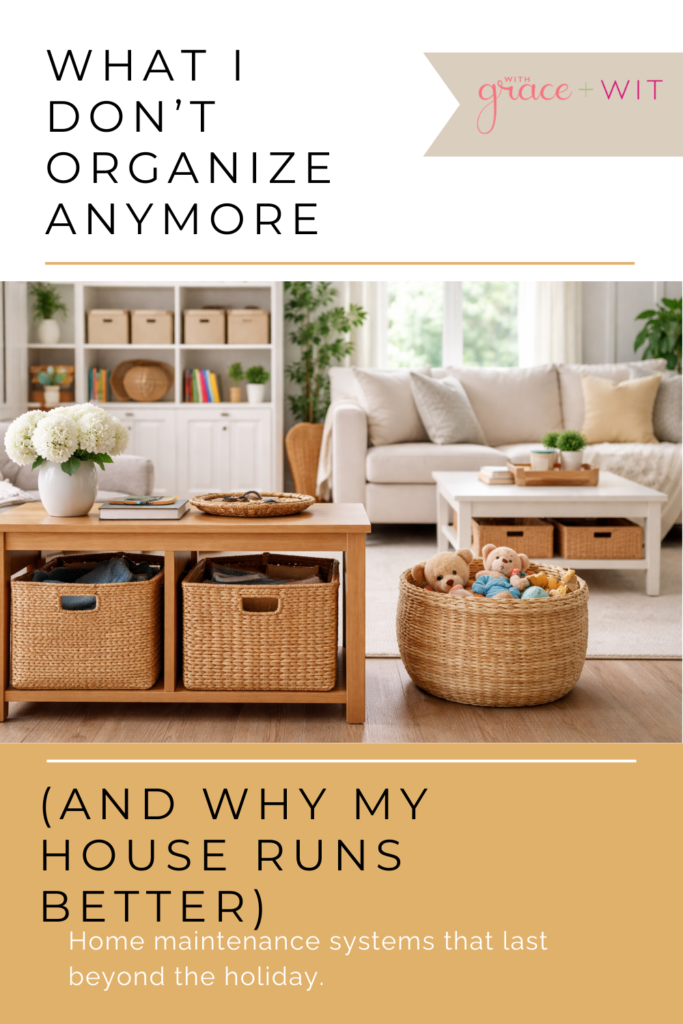
Now, I ask one simple question: Can my child reset this space in ten minutes? If the answer is no, the system is too complicated. We’ve traded hyper-specific, labeled bins for “dump zones.” We use large baskets for toys and one massive tub for crafts. Stuffed animals go on a single shelf instead of being arranged by size.
It’s about containment over categorization. I’m not lowering my standards; I’m just designing a system that actually works in motion.
3. All-or-Nothing Aesthetic Organizing
I don’t organize for looks alone anymore. I love a pretty pantry, but I’ve quit the “all-or-nothing” approach.
For example: my pantry isn’t decanted perfection — but it’s not chaotic either.
Breakfast foods have a labeled bin. Cereal, oatmeal, pancake mix — all in original packaging, grouped together. Flour, sugar, and rice go into sturdy labeled containers because they’re easier to measure and make less mess that their original containers when using. The hard sides help my kids scoop without flour ending up everywhere.
It’s not about choosing between “fancy” or “functional.”
It’s about asking:
Where does structure genuinely help?
And where is it just adding maintenance?
If a system adds a constant “maintenance tax,” I rethink it. If it makes life smoother, even if it’s one extra step at grocery unpacking, I keep it. Organizing isn’t a moral issue. It’s a math equation.
Does the effort pay you back?
4. Every. Single. Drawer.
I don’t organize or attain to organize every drawer in my house anymore. Some drawers are simply “miscellaneous on purpose.” Because here’s the truth: not every object needs a micro-category. Spare change, random charging cords, the random LEGO the vacuum picked up, a marble, extra hooks. If you try to give every tiny item its own perfectly labeled home, you’ll burn out.
Instead, I designate miscellaneous spaces. A junk drawer in the kitchen. A catch-all basket in the mudroom. A small bin in the office closet. A basket for rogue game pieces.
When counters start collecting random life debris, I know exactly where it goes. That one messy drawer often protects five other surfaces from becoming cluttered. That’s a trade I will take every time.
5. Low-Impact Areas
I stopped obsessing over spaces that don’t cause me stress. The linen closet? If I can grab a towel in ten seconds, we’re done. The top shelf of the coat closet? If it’s not falling on someone’s head, it’s fine. Not every corner of your home needs optimization. Some areas simply need to be safe and usable.
I focus on the systems that make or break our week:
- Laundry flow
- Meal planning
- School paper management
- Entryway and mudroom zones
- Toy containment
Alphabetizing spices when you don’t even like cooking? Low impact. Let it go so you have the energy to prevent a 5 p.m. meltdown instead.
6. The “Just in Case” Overflow
Managing a mini-warehouse is exhausting. I stopped organizing massive backstock—twelve rolls of wrapping paper, five extra shampoos, a clearance-bin stockpile I forgot I had. Having a small buffer is wise; managing an inventory is a job. Fewer duplicates mean fewer overflowing shelves to maintain.
Why Doing Less Made Us Stronger
When I stopped trying to organize everything, I finally had the energy for what actually stabilizes our home: the weekly reset. Because I’m not busy fine-tuning micro-systems, I can spend twenty minutes getting the whole house back to a baseline. Floors clear. Laundry moving. Surfaces reset. I realized I couldn’t be a professional organizer and a present mom at the same time. I chose “present,” and ironically, the house actually runs better now.
Your 10-Minute “Sanity” Action Plan
Ready to reclaim some of your own energy this week? Try these two things:
- Identify one “Maintenance Tax” system: Find one area you’re constantly “fixing” or tidying. Can you simplify it? (e.g., Switch the color-coded toy bins for one big basket).
- Pick your “Low-Impact” zone: Choose one closet or drawer you’ve been feeling guilty about and officially give yourself permission not to organize it this month.
Choosing what not to do isn’t laziness—it’s discernment. Your time is a limited resource. Spend it on the things that give you peace, not the things that just look good on a label.