Every few weeks, something tips the scales and I’ve had it with the clutter. Where did it come from? I just put everything away!
The sewing box is sitting out because I still need to hem a pair of pants. A pair of gardening gloves is waiting to be put away because they were too wet to store when I finished gardening last week. There are three small piles of mail: one on the kitchen counter, one on the table, and one on the buffet. Shoes are in several places because several people didn’t feel like putting them away today.
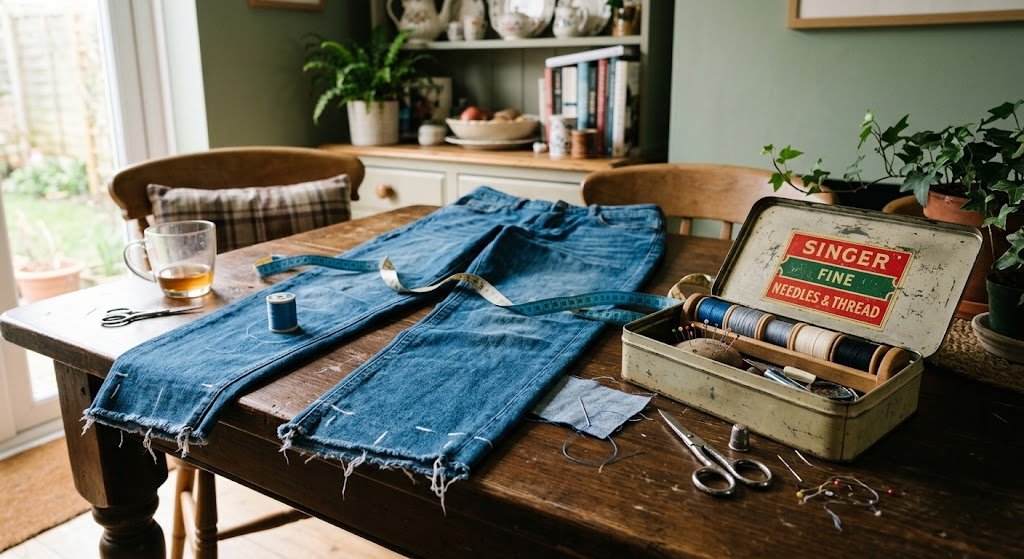
At that point, I do a deep dive and put everything away. The house feels better. The surfaces are clear. The unfinished things are finished or put back where they belong.
And then, a few weeks later, I look around and find a new collection of things waiting for me.
Today we’re talking about the everyday household work that accumulates between cleanups: the things that don’t get put away, the things waiting to be dealt with, the things that don’t have a home, and the things that keep landing in the same places.
Cleaning doesn’t solve everything
Cleaning and managing stuff overlap, but they aren’t the same thing.
Cleaning deals with the things that make a house dirty: wiping the counters, vacuuming the floors, dusting, cleaning the bathrooms, doing the dishes. It keeps the house clean and sanitary.
Managing stuff is different.
You can clean a kitchen counter every day and still have a pile of mail that keeps returning to it. You can vacuum the floor and still have shoes scattered around the house. You can straighten the living room and still have a project sitting on the coffee table three days later.
Managing stuff asks different questions.
Where does the mail go? Where do the shoes go? What happens to the project when you aren’t working on it? Where do the things go that need to be dealt with later?
If these questions don’t have a clear answer, you have a household system problem. That’s why a house can look fine after a big cleaning effort and start accumulating clutter again within days. The cleaning worked. It just didn’t change what caused the accumulation.
This is how the catch-up cycle develops:
things accumulate → you notice the buildup → you do a big cleanup → everything looks better → the same things start accumulating again
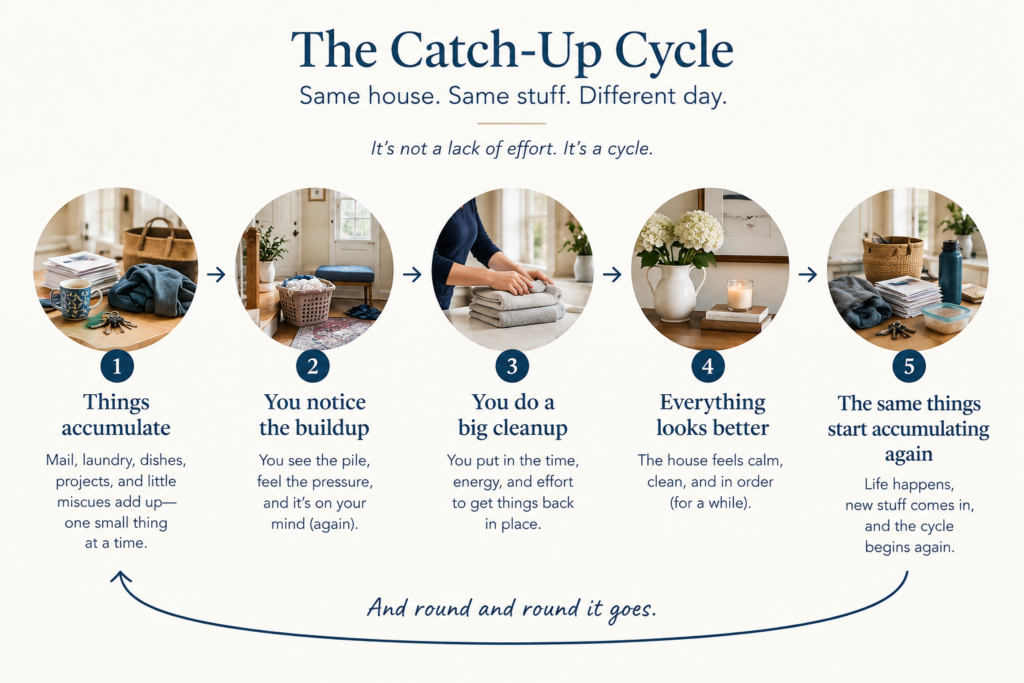
The big cleanup works, which is why we keep doing it. But if you’re repeatedly cleaning up the same kinds of things, it’s worth looking at why that type of clutter keeps getting left behind.
Look at where things land
Most homes have places where unfinished household work tends to collect.
For me, it’s the buffet in our dining room and the top of the stairs. The buffet is a flat surface we don’t regularly use, which makes it an easy place for things to accumulate in plain sight. The top of the stairs becomes a convenient stopping point for things that need to go somewhere else.
I think of these as landing spots. A landing spot isn’t necessarily a bad place. Things temporarily land somewhere for perfectly good reasons. The useful question is what happens after they land there.
Does the item eventually make it to its home? Does someone know what is supposed to happen next? Is there a convenient place for it to go? Or does it sit there until someone finally gets tired of looking at it?
A routinely problematic landing spot is useful information. It tells you where household work is getting stuck.
And there are a few reasons that happens over and over.

Four reasons things don’t get put away
When I look at my own piles, they usually come down to one of four problems.
1. “I’ll need it again soon.”
Sometimes the thing isn’t actually ready to be put away.
The sewing box is a good example. I’m not finished with the pants, so putting the sewing box back where it belongs would mean getting it out again later. Leaving it where I can see it makes sense while the project is active.
The problem comes when “I’ll need it again soon” has no end point.
A project that was supposed to take an afternoon is still out the following week. Then you start another project. Before long, everything is left out indefinitely. This doesn’t mean everything needs to be put away immediately. It means temporary things need some way to become finished things.
2. The proper home is too far away.
Sometimes an item has a home. You just don’t want to make the trip.
The gardening gloves are a small example. They were wet, so I didn’t put them away when I finished gardening. Now they need to make their way back to where they belong, even though I’m no longer thinking about gardening.
This happens all over a house.
Something belongs downstairs, but you’re upstairs. Something belongs in the garage, but you’re already in the kitchen. Something belongs in a closet, but getting it there means opening the door, moving something else, or finding space for it.
When the proper home requires more effort than leaving the item where it is, leaving it there will sometimes win.
3. “Put away” means different things to different people.
An item can technically be in the right room and still not be put away.
Maybe the shoes are supposed to be in the closet, but they’re on the floor in front of the shelves. Maybe the sweater is in the bedroom, but it’s sitting on the chair instead of folded or hung. Maybe something is on a counter because one person considers that close enough to its home.
This is where a household can have a perfectly good place for something and still have a recurring problem. The issue isn’t always where something belongs. Sometimes people simply have different ideas about what it means for something to be put away.
4. The system doesn’t account for something new.
What happens when you get something new? A new kitchen gadget. A new school supply. A new piece of sports equipment. A new appliance. A new hobby. A new piece of furniture.
Sometimes there is an obvious place for it. Sometimes there isn’t.
When something new doesn’t have an immediate home, it tends to land somewhere nearby. Something with a home may be moved to accommodate it, and before long, both things lose their place. An arrangement that worked reasonably well before is suddenly crowded or no longer works at all.
One new item can expose a problem that was already there. That’s why clutter isn’t always a matter of having too much stuff. Sometimes the household simply hasn’t decided what happens when something new arrives. Every one of these situations is a little different, but they have something in common: the next step isn’t easy.
The item is waiting for something. The home is inconvenient. The definition of “put away” isn’t clear. Or the household has changed and the old arrangement no longer works.
That’s where stuff—and the work to put it away—starts to accumulate.
Give the pile a different question
When you find yourself repeatedly putting the same things away, don’t start by asking how to clean it up faster.
Ask:
What is this waiting for?
- A pile of mail might be waiting to be sorted.
- The sewing box is waiting for the pants to be finished.
- The gardening gloves are waiting to dry and be put away.
- Shoes are waiting to be returned to wherever the household has decided shoes belong.
- A project on the table may be waiting for its next work session.
This question changes what you do next.
Some things need a one-time decision. The new kitchen gadget needs a home. Once you decide where it lives, the problem should be finished.
Some things need a rhythm. Mail needs to be dealt with regularly. Laundry needs to move through the house. The fridge needs to be checked and restocked.
Some things need a temporary place with an ending. A holiday project, a party, or a home project can take over a surface for a while. That’s fine. The problem is when the temporary arrangement has no clear end.
You don’t need to treat every pile as a failure that needs immediate elimination. You need to know what kind of thing you’re looking at.
Change what makes the next step difficult
This is where a small change can matter more than a bigger cleaning effort.
If the mail keeps landing on three different surfaces, the answer may not be “sort the mail more often.” It may be deciding where mail goes when it comes into the house and making that place easy to use.
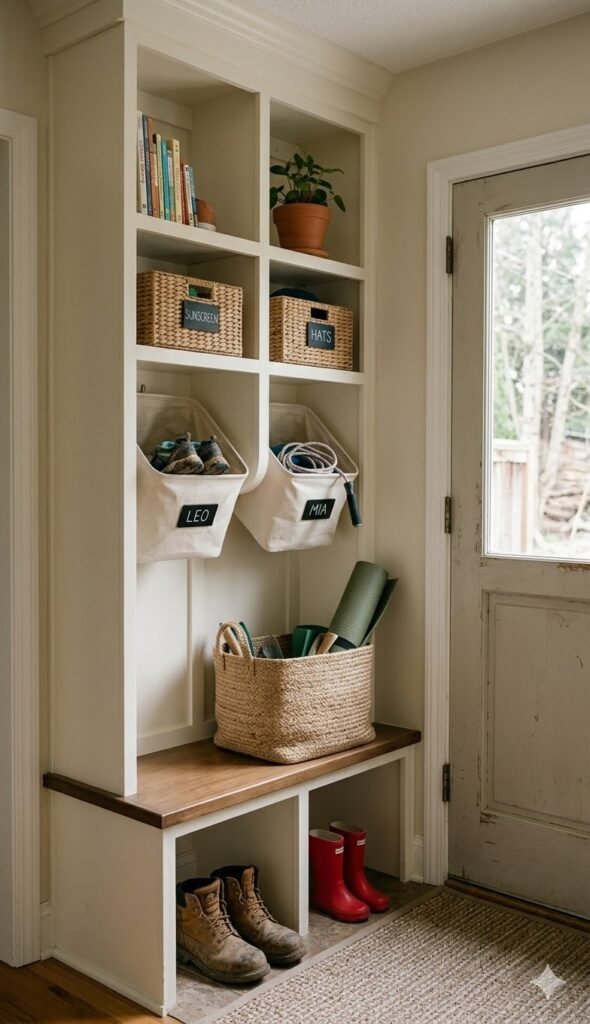
If shoes are always scattered, the answer may not be another reminder to put shoes away. The storage may need to be closer to where everyone takes them off, or the definition of “put away” may need to be simpler.
If a project stays out for weeks, you may need a defined place for unfinished projects rather than pretending every project can be completely cleaned up between work sessions.
If a new item doesn’t fit, you may need to make a decision about what else has to move.
The goal isn’t to create a house where nothing is ever left out. It’s to make the next step obvious enough and easy enough that things don’t continually stop there.
A 10-minute landing-spot audit
Look around your house and find three places where things regularly accumulate.
Don’t pick the places that are messy because you had company last night. Look for the places that seem to regenerate the same kinds of clutter.
For each one, ask:
- What’s landing here?
Be specific. Mail, shoes, projects, things waiting for another room, things that need to be returned, things that need a decision. - What is it waiting for?
Does it need to be finished, sorted, moved, returned, used again, or given a home? - Why isn’t the next step happening?
Is the proper home too far away? Is there no home? Is “put away” unclear? Did something change? - What would make the next step easier?
A closer storage spot? A defined place for unfinished projects? A simpler rule? A regular time to deal with it?
Choose one of your three places. Pick the one that creates the most repeated work and change one thing. Then pay attention. If the same pile forms again next month, that’s useful information too.
The goal is to stop falling behind
I do think the goal is a house where everything is put away. That doesn’t mean everything will be put away all the time. Things will be left out. Projects will take longer than expected. Mail will accumulate. Someone will take off their shoes in the wrong place. A wet pair of gardening gloves will sit on the porch longer than intended.
That’s normal.
The difference is whether those things eventually move through the household or whether they keep getting stuck in the same places until you have to do another big cleanup. You don’t need to clean harder. You need to pay attention to where things keep getting stuck and make the next step easier.
This week, take ten minutes and do the landing-spot audit. Find three places where things regularly accumulate, figure out what they are waiting for, and change one thing that makes the next step difficult.
You may not solve the whole problem in ten minutes. But you might find out why your house keeps falling behind.
Next week: the home maintenance tasks we forget until they become a problem.