There’s a version of summer that looks really good on paper. Color-coded calendars. Enrichment activities Monday through Friday. A morning routine printed and laminated on the fridge.
And then there’s the other version — where by week two, nobody has brushed their hair, the kids are still in pajamas at noon, and the rat’s nest situation has officially ruled out playing with the neighbors.
We’ve tried both. Neither worked for us.
If you’ve ever swung between those two extremes — white-knuckling a schedule on one end, watching everything unravel on the other — you’re just missing a third option.
It’s not a schedule. It’s not a free-for-all. It’s something in between, and once you find your family’s rhythm, summer starts to actually feel like summer again.
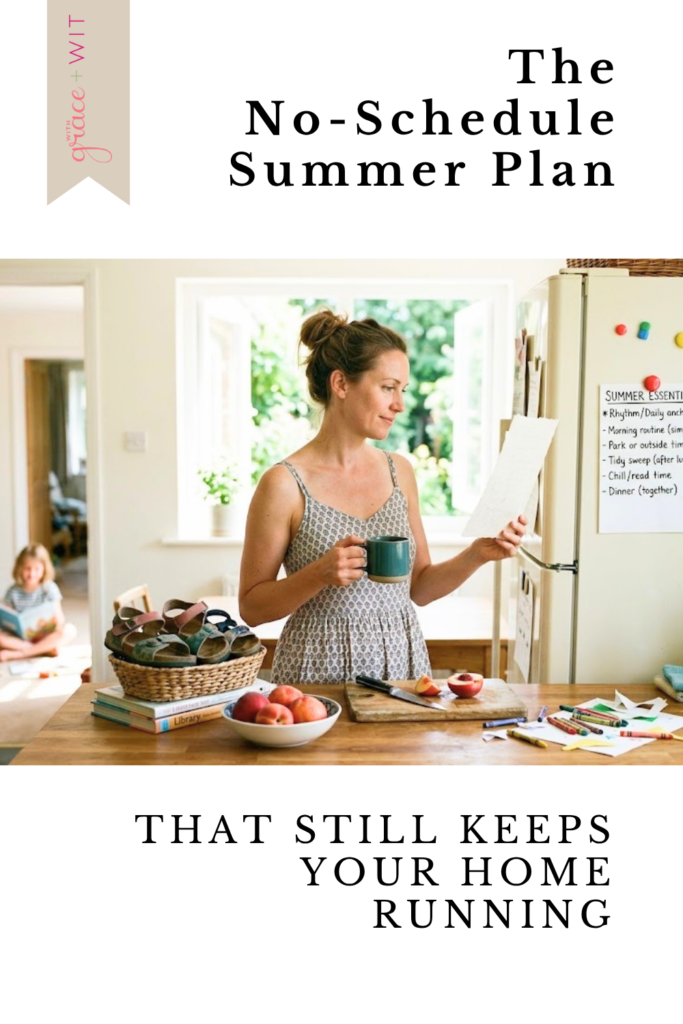
Why Schedules Fail (And Why No Structure Is Worse)
Here’s the honest version of what over-scheduling summer actually feels like: you become the ringmaster. You’re the one watching the clock, tracking who needs to be where, calling out “you have ten minutes to finish getting ready, we have to go.” Every. Single. Day.
It’s exhausting. And it stops feeling like a gift to your kids and starts feeling like a second job — one where the staff is resistant and the benefits are unclear.
But the total-freedom version isn’t the answer either. Without any expectations, basic needs quietly become optional. Breakfast becomes a snack at 11. Clothes feel negotiable. Personal hygiene becomes a negotiation. And the longer it goes, the harder it is to course-correct — not because your kids are bad, but because nobody gave the day a shape.
Kids, even the ones who push back hardest, do better when they know what to expect. Not a minute-by-minute schedule. Just a shape. A rhythm they can count on.
That’s where anchors come in.
Anchors, Not Schedules
An anchor is different from a schedule. A schedule says what happens when. An anchor says this will always happen, and everything else floats around it.
Anchors don’t require you to be the timekeeper. They don’t fall apart when someone sleeps in or a spontaneous lake day appears. They just hold the day together at the edges — which, it turns out, is usually enough.
In our house, the anchor that does the most work isn’t a morning routine. It’s an evening reset.
The Morning Window (Not a Morning Routine)
This summer is a transitional one — we have middle and elementary schoolers. Their mornings will look different, their rhythms won’t match, and that’s okay.
What we do have is a window, not a schedule. Everyone needs to be dressed, fed, hair done, and teeth brushed — but the deadline is flexible depending on what the day holds. (If your kids need “ready” defined, that’s a separate conversation — “ready” means dressed, fed, teeth brushed, hair done — not a moving target.) Some days that’s 9 am. Other days, if we have nowhere to be, it stretches to 11. At that point, breakfast and lunch start blurring together, which is a summer right of passage if you ask me.
The window gives kids ownership of their morning without leaving them completely adrift. They know what “ready” looks like. They just get to decide when they get there — within reason.
This small shift moves you out of the role of morning drill sergeant. You’re not chasing anyone down. You’ve set the expectation; they’re responsible for meeting it.

The Natural Midday Shift
You probably already have a midday anchor and haven’t named it yet.
In a lot of families, lunch is that moment. Not a formal sit-down necessarily, just the point where the morning activities wind down and something different begins. In our house, the day naturally shifts as the temperature does. Kids who were outside in the morning drift inside when it gets hot. On a really hot afternoon, someone usually rediscovers the sprinklers and it reverses entirely.
You don’t need to engineer this. You just need to notice it’s already happening and let it work for you.
Lunch is a natural pause. It’s a chance to check in, refill, and loosely plan the afternoon — not with a schedule, but with a conversation. *What do you want to do this afternoon? Did you finish what you needed to? What are we doing for dinner?*That’s enough.
The Evening Reset: The Anchor That Does the Most Work
If you only implement one anchor this summer, make it this one.
The evening reset is not a deep clean. It’s not an overhaul. It’s the moment — tied to dinner, to winding down, to whenever it fits your family’s rhythm — when the day’s “sprinkles” get put back where they belong. Some nights that happens right before dinner. Some nights it slides to just before bed. The timing moves; the habit doesn’t.
Kids’ things left in the living room or kitchen go back to their owners. Common spaces get a quick pass. It’s not a production; it’s a habit.
The reason this works better than a morning tidy or a midday cleanup is that it closes the day. It creates a consistent endpoint. The house doesn’t accumulate chaos overnight, which means mornings start calmer — without anyone having to be in charge of making that happen.
In our house, kids are responsible for their own things in the common areas. Bedrooms and the play space get handled as part of their regular chores on a rotation. The evening reset isn’t about perfection; it’s about frequency. Things get put away on a consistent enough basis that they don’t become an overwhelming project.
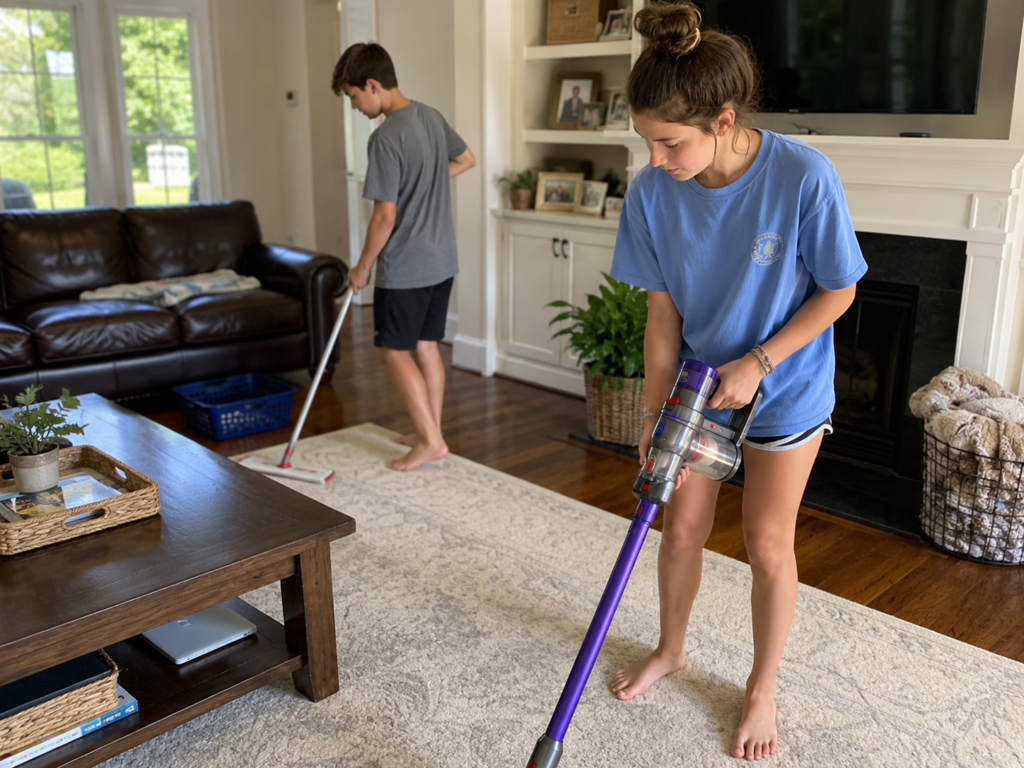
The reset also signals something to kids, even if they can’t articulate it: the day is wrapping up. It’s a transition cue. A small act of care for shared space. And over time, it becomes one of those things that just happens — not because you enforced it, but because it’s woven into the rhythm of the day.
What Anchors Actually Do
A schedule manages time. Anchors hold space.
When you have a few reliable anchors in place, the hours in between them can be genuinely free — because there’s a container around them. The kids aren’t drifting into an endless, shapeless day. They know the morning has an endpoint. They know the evening has a reset. Everything in the middle is open.
This is the middle ground that actually feels like freedom — for them and for you.
You’re not the ringmaster anymore. You’re not tracking every hour. You’ve built a few reliable moments that hold the day together, and then you’ve let the rest of summer be summer.
Last year we used a daily to-do framework as its own kind of anchor — here’s the thinking behind it, and here’s what actually happened when we put it into practice. Both are worth a read if you want more on building independence into the structure.
How to Build Your Own Anchors
You don’t need to copy our specific anchors. You need to find the ones that fit your family’s natural rhythm. Here’s how to figure out what those are:
Look for what’s already happening. Is there a moment in your day that naturally acts as a transition? Lunch? Sport camps or another activity? The post-nap window? When the afternoon heat drives everyone inside? That’s probably where your anchor belongs.
Pick the one problem that takes the most out of you. If mornings are chaos, a morning window anchor might help most. If the house feels wrecked by evening, start there. Don’t try to fix everything at once.
Keep the expectations attached to the anchor small. An anchor isn’t a checklist. It’s one or two things that consistently happen at roughly the same time. Everyone ready by 10. Everything in common areas put away before bed. That’s it.
Give it two weeks before you judge it. The first few days, you’ll have to remind everyone. After a week, it’ll start to stick. By week two, you’ll notice the day feeling different — not because everything is perfect, but because there’s a shape to it.
The Real Goal
The goal this summer isn’t a perfect routine. It’s a home that functions without you managing every hour of it.
That means kids who know what “ready” looks like and can get there on their own. A house that resets itself through consistent small habits rather than occasional big cleanups. A summer that actually has room in it — for spontaneity, for boredom, for the good kind of slow.
You don’t need a color-coded calendar for that.
You just need a few anchors, and the willingness to let the rest float.
Looking for more on building flexible structure into your summer? Check out the Repetition Reset — a 10-minute diagnostic for finding what’s creating recurring chaos at home, so you can close it once instead of solving it every week.