Picture this: you’re coasting along, finally feeling like you’ve caught your rhythm—and then everything stacks up at once. It’s Tuesday. You have a dentist appointment across town in twenty minutes. One kid has practice, another has something completely different across town—dance, chess club, theater, take your pick—and you just remembered you signed up to bring something… somewhere.
It’s not that your life is unusually chaotic. It’s just full. And when you don’t see it coming, full quickly turns into overwhelming. The stress of a forgotten appointment—especially when other people are depending on you—is real. It’s the frantic text for a last-minute carpool, the expensive takeout because you missed the school event on the calendar, and the mental drain of constantly reacting instead of seeing it coming.
This is exactly why I started figuring out how to plan my month in a way that actually works in real life—not just on paper. I’ve tried a lot of planning systems over the years—block scheduling, “top three” priorities, detailed checklists. Some worked for a season, but most didn’t hold up in a home where schedules shift and the headcount changes.
But in a busy home, even the best system breaks the moment the schedule stops going according to plan. And if I’m honest, not planning didn’t mean I was “free.” It just meant I was relying on my memory and hoping I’d remember something I scheduled five weeks ago. Now, I don’t schedule every minute of my day. I don’t maintain elaborate calendar systems that become a chore. And I don’t force routines that feel claustrophobic.
I plan for an intentional month—with a simple monthly planning routine that takes about 30 minutes.
Before we dive into the system, if you feel like you’re constantly fighting the same fires every week, grab my Repetition Reset Checklist. It will help you spot those recurring stressors so you can build rhythms that actually stick.
The Goal: How to Plan Your Month with Intentionality
Let’s be honest: “calm” can be a misleading word. It sounds like life will be quiet and easy. But with teenagers, sports, and a blended family, life is rarely calm.
The goal of this monthly planning routine isn’t to make the month easy—it’s to make sure you aren’t surprised by the hard parts.
It’s about directional clarity.
When you can see the pressure points ahead of time, you can plan around them instead of getting taken out by them.
Step 1: The Pressure Point Sweep (10 Minutes)
The first step in this monthly planning system is to look for the one-offs.
I’m not paying attention to regular school drop-offs or the weekly practice we’ve done for three months. I’m looking for anything that disrupts the normal rhythm:
- Appointments: dentist, doctor, or that haircut you scheduled six months ago
- School calendar: half-days, conferences, spirit days, or anything that requires extra prep
- Social & travel: birthdays, family plans, or weeks my husband is traveling
Action Tip: Mark these clearly. These are the days your normal rhythm won’t work.
Step 2: The Capacity Check (5 Minutes)
Once the pressure points are mapped out, I step back and look at how full the weeks are.
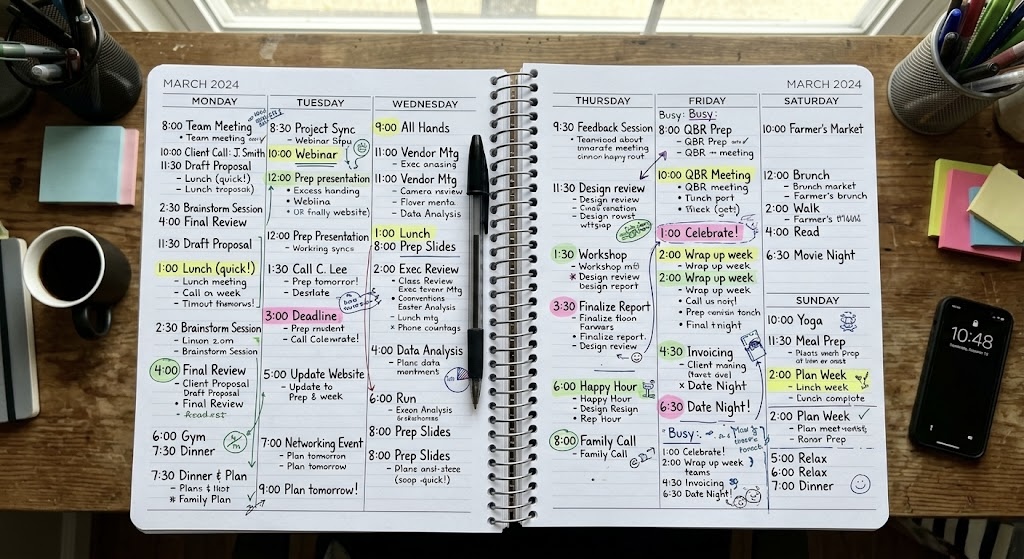
- Identify the heavy weeks:
If one week has multiple evening commitments plus a traveling spouse, that’s a full week. - Adjust expectations ahead of time:
That’s when I decide it will be an “easy meal” week (frozen pizza, simple dinners), or when I text a friend early to coordinate carpool.
Asking for help two weeks in advance feels like a plan.
Asking ten minutes before pickup feels like a panic.
This is the difference between planning your month ahead of time… and standing in your kitchen at 4:42 trying to figure out how to be in two places at 5:00.
Step 3: The Source of Truth (10 Minutes)
In our house, we use our home calendar system with two large paper monthly calendars (this month and next).
This part of my monthly planning routine is where my digital and physical calendars come together.
I plan far into the future on my phone—appointments six months out, school dates at the beginning of the year. But those don’t always make it to the wall calendar right away. And sometimes things get added to the wall that never make it into my phone.
This is my checkpoint to make sure both calendars match—nothing living only on my phone or only on the wall. That way, whether I’m at home or on the go, I know I’m looking at an accurate version.
If it’s not on the wall calendar, it doesn’t exist for the rest of the family. This step makes sure we’re all operating from the same source of truth.
(I’ll share more in a future post about how we’ve set this up in our home and why it works so well for our family.)
Step 4: The Supply Scan (5 Minutes)
The final step in this simple monthly planning system is making sure we’re physically ready for what’s coming.
- Do we have a gift for that birthday party?
- Are the cleats clean for the weekend tournament?
- Do I need a grocery order—or are we about to have a very creative “what can we make out of nothing” kind of week?
This is where small preparation prevents last-minute stress.
Moving From the Plan to the People
A plan only works if the people involved know it.
Once my 30 minutes are up, I do a quick family “weather report.” This isn’t a formal meeting—it’s just a simple heads-up.
I’ll flag the fuller weeks, mention any schedule conflicts, and make sure everyone has a general sense of what’s coming over the next few weeks.
We already talk through our schedule weekly (and often daily), but this gives us a bigger-picture view so nothing sneaks up on us.
This is one of the simplest ways to stay organized with a busy family schedule—making sure everyone can see what’s coming.
This isn’t overkill—it’s communication. It moves the burden of “keeping track of everything” off of me and into a system the whole house can see and use.
The Real Goal
The goal isn’t order—it’s ease.
When you take time to plan your month ahead, you give yourself the gift of being present when it actually happens.
You’re not constantly wondering what’s next.
You already know.