Somewhere along the way, we were sold the idea that running a home well means running it like a business. We adopted the language of workflows, optimization, and KPIs—applying them to meals, mornings, and motherhood.
For a while, that framing feels empowering. Until it becomes exhausting.
Homes are not businesses. They don’t scale. They don’t clock out. And the people inside them are not employees. A thoughtful home doesn’t need management theory; it needs simple systems that support real life.
The Quick Read: Why be realistic about home management?
- Why the “home as a business” model eventually backfires.
- How to shift from optimization to stability.
- A Case Study: Why granular labeling is the enemy of the busy mom.
Businesses Optimize for Output. Homes Exist for Care.
A business is designed to maximize efficiency and growth. A home is designed to sustain people. When we borrow business logic too literally, we start measuring the wrong things: How fast can this be done? How much can I handle? How can I squeeze more into the day?
This is where many moms quietly burn out—not because they lack systems, but because their systems are built around productivity instead of support.
This connects directly to A Thoughtful Home Is Not About Doing More—It’s About Deciding Once. Decisions reduce friction, but only when the goal is livability, not output. To see the difference, we have to look at the underlying logic:
| Feature | The Business Mindset (The Burden) | The Home System (The Relief) |
| The Primary Goal | Efficiency: How fast can we finish? | Capacity: How much “peace” can we keep? |
| Scheduling | Rigid Time-Blocks: “Lunch is at 12:15 PM sharp.” | Natural Rhythms: “We eat when the baby wakes up.” |
| Organization | Granular Labeling: 12 categories of toys in specific bins. | Broad Grouping: One “Lego” bin, one “everything else” bin. |
| Success Metric | Excellence: Pinterest-perfect, staged counters. | Stability: The dishes are done enough to make coffee. |
| Personnel | Compliance: Everyone must follow the manual. | Compassion: The system bends when someone is sick. |
| Failure Mode | Bottlenecks: If Mom is sick, the “company” stops. | Fail-Safes: A “frozen pizza” backup for heavy days. |
An example of Broad Grouping vs. Granular Labeling
To understand why “Business Logic” fails at home, look at the playroom or the pantry.
The Business Approach (Granular Labeling): You buy 10 matching bins. You label them: Action Figures, Cars, Blocks, Animals, Puzzles, etc. It looks beautiful for a photo. However, this system requires “High Compliance.” Every time a child plays, they (or you) must perform a 10-step sorting process to reset the room. When you are tired, the system breaks. The toys stay on the floor because the “cost” of sorting is too high.
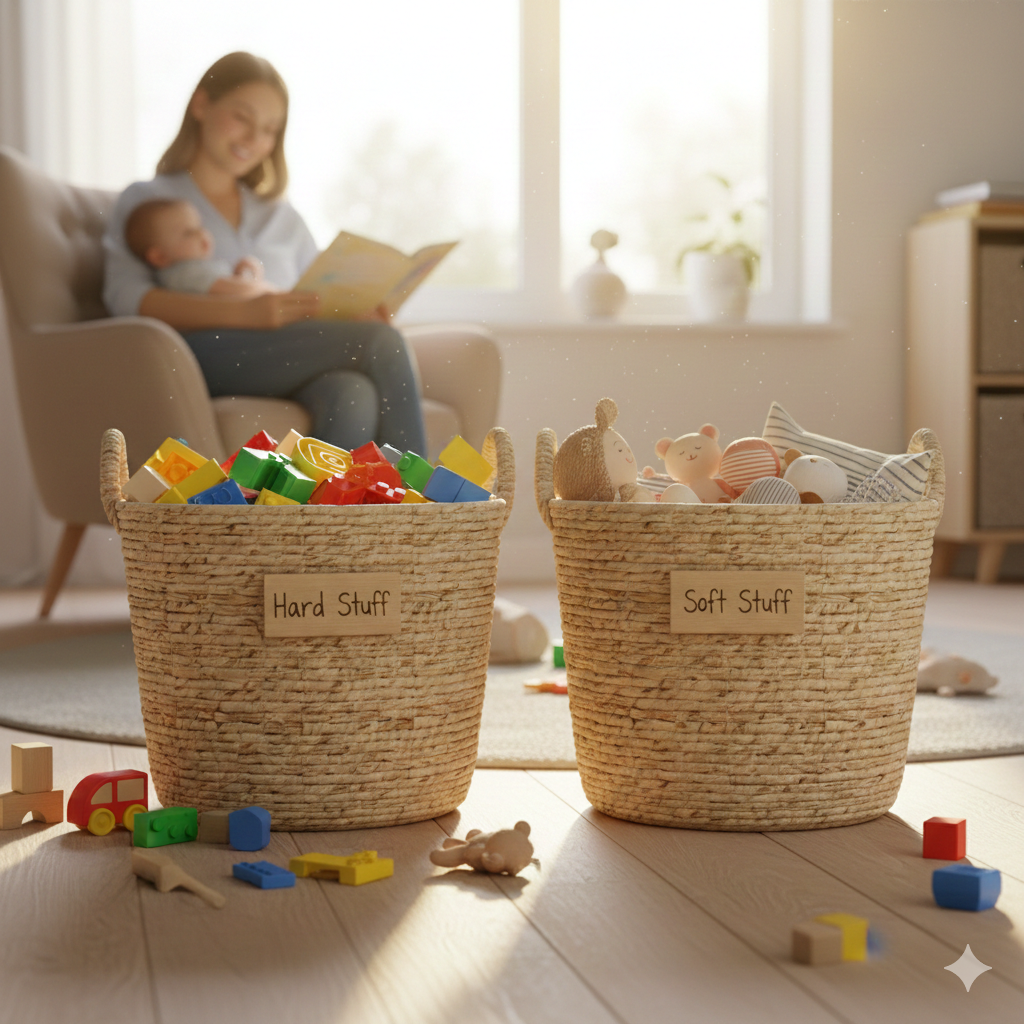
The Home System (Broad Grouping): You have two large baskets. One for “Hard Stuff” (blocks/toys) and one for “Soft Stuff” (stuffies/pillows).
- The ROI: A “reset” takes two minutes instead of twenty.
- The Result: The room stays functional even on low-sleep days because the barrier to success is low.
A home system assumes you are human and tired. It favors a “fast sweep” over “perfect placement.”
Simple Systems Assume Humanity
A business system assumes compliance. A home system must assume variability. Not everything needs a system, and the ones you do keep should survive disruption.
Think of your systems as:
- Defaults, not procedures
- Rhythms, not schedules
- Guardrails, not rules
If a system requires constant monitoring, frequent “retraining,” or your full attention to function… it’s too complicated for home life.
The Goal Is Stability, Not Excellence
A simple system is one you can maintain on your hardest days. A thoughtful home chooses “good enough” routines over perfect ones and predictability over novelty. The win isn’t doing something impressively—it’s doing it consistently without resentment.
When we treat our homes like businesses, we start performing for them. But a simple system is quiet. It works in the background. The goal isn’t control; it’s capacity. A home that runs simply leaves room for relationships, rest, and recovery.
Your Practice Step: De-Business One Area
Choose one area of your home that feels over-managed: meals, mornings, cleaning, or schedules. Ask yourself:
- Where am I tracking or optimizing unnecessarily?
- What would this look like if it were designed for care, not efficiency?
- Can I move from “Granular” to “Broad”?
Remove one layer. Simplify one rule. Let the system serve the people—not the other way around.