Some homes appear naturally orderly.
It can be tempting to assume this is a matter of temperament.
It is not.,
Order is rarely the result of enthusiasm or aesthetic preference. It is almost always the outcome of a few decisions made early and repeated gently.
This is encouraging, because it means order is learnable—and adjustable.
A 30-second overview.
A thoughtful home is not built by doing more. It is built by deciding a few things clearly:
- Disorder usually comes from unanswered questions, not laziness or lack of care
- The best home organizing systems reduce thinking, especially when energy is low
- Order lasts when it works on ordinary days, not ideal ones
This post builds on last week’s idea—“A Thoughtful Home Is Not About Doing More—It’s About Deciding Once”—by showing what those decisions actually look like in daily life.
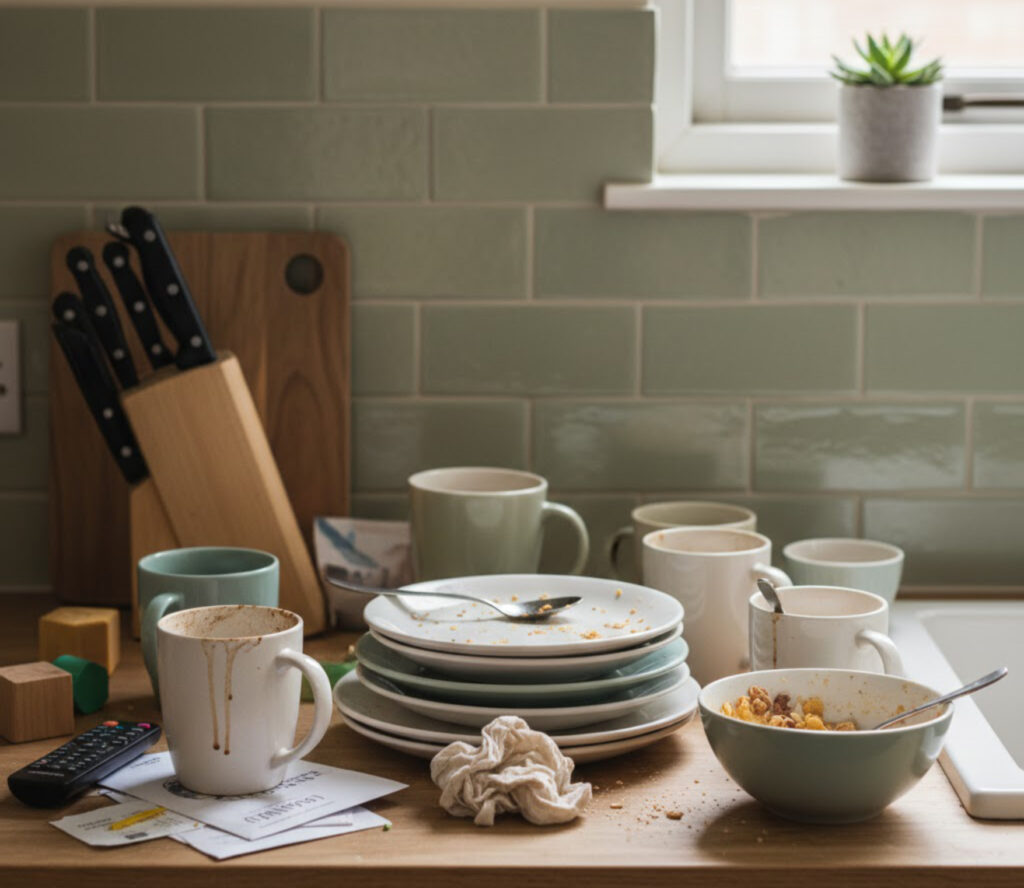
Most household disorder comes from ambiguity, not neglect
Homes tend to unravel in the same places:
- papers without a clear destination
- items without a default home
- routines that depend on motivation
These are not moral failings. They are structural ones.
Where there is ambiguity, clutter gathers. Where there is clarity, things settle.
Order begins when the home answers simple questions consistently.
For a busy mom, these questions are practical and repetitive:
- Where do school papers go the moment they enter the house?
- What is the fastest acceptable way kids’ clutter lands and gets recovered?
- How does food move from planning to shopping to feeding people—without daily renegotiation?
When the home cannot answer these questions quickly, the brain fills in the gaps. Clutter is often the visible residue of too many micro-decisions.
A system earns its place when it reduces thinking
A useful system does not ask to be remembered.
It works because it is obvious.
If a system requires frequent explanation or motivation, it is too complex for everyday life.
The best home organizing systems:
- assume fatigue
- survive interruptions
- resume without ceremony
They make the right action the easy one—even on low-energy days.
Not every area of the home deserves the same level of structure
One common mistake is over-systematizing.
Some areas benefit from precision—paperwork, finances, schedules.
Others thrive with flexibility—creative spaces, weekends, relationships.
A thoughtful home does not aim for uniform structure.
It aims for appropriate structure.
Repetition is more powerful than novelty
Many organizing routines fail not because they are wrong, but because they are temporary.
A thoughtful home values what can be repeated on an ordinary Tuesday.
If something only works in ideal conditions, it will eventually be abandoned.
Order is sustained by familiarity, not excitement.
Order should make life quieter, not more impressive
There is a subtle temptation to build systems that look good but feel heavy.
If maintaining order becomes a performance, it will not last.
The purpose of order is to:
- reduce friction
- shorten recovery time
- protect attention
Anything else is decoration.
A thoughtful home leaves room for humor
No system accounts for every variable.
Grace shows up in how the system bends:
- a missed reset
- a cluttered counter
- a week that simply needs to be written off
Order that cannot tolerate reality is not thoughtful—it is brittle.
You can tell a system is working when it fades into the background
The success of a home organizing system is measured by how little it announces itself.
When order becomes unremarkable—when the home supports the day without commentary—you have chosen well.
That is the aim: not visible control, but quiet reliability.
A practical next step
Identify one area where disorder repeats and ask:
What decision has not been made clear enough to hold?
That’s exactly what the Repetition Reset was designed for. It’s a free 10-minute diagnostic that walks you through the specific household problems that keep repeating — and helps you identify the unmade decision underneath each one. [get it here]
Then simplify the answer until it can survive a busy week.
This does not mean fixing everything at once. It means choosing the next manageable improvement, given real constraints like time, energy, and budget.
A system does not need to be perfect to be effective.
It only needs to be clear enough to be repeated.
This series continues next with:
Sustainable Home Systems Are Designed for Ordinary Days, Not Ideal Ones.
Because the goal of a thoughtful home is not control—it is support. And support works best when it is built for real life.